
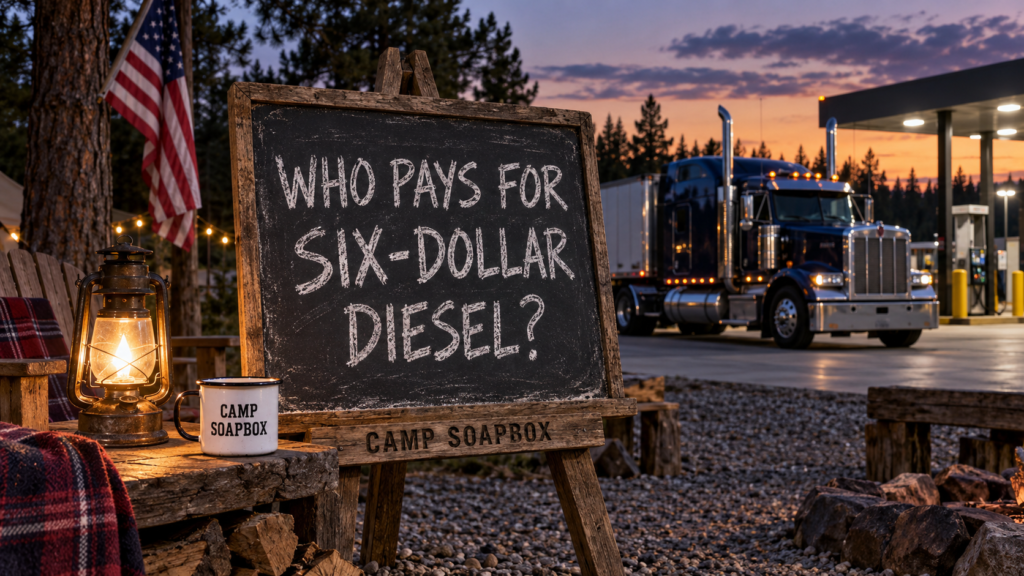
Ok folks, your Camp Soapbox counselor here.
Nothing will ruin a perfectly good rant faster than doing the arithmetic.
I started digging into diesel prices because I was convinced I already knew what I was going to find. Crude oil was about the same price it had been before, diesel was nearly six dollars a gallon, and somebody between the oil well and my fuel tank had to be sticking it to us.
That was my theory.
Then I checked the numbers.
Some of my argument held up. Some of it did not. Since I am the fellow who keeps telling everybody else to check the math, I suppose I ought to do the same even when the math disagrees with me.
Let’s start with where we are.
The latest EIA national average for on-highway diesel was $5.967 per gallon. AAA had its national diesel average even higher at approximately $6.23.
My own fuel records tell the same story.
From January 1 through September 12, 2025, the posted retail price on my fuel purchases averaged $3.640 per gallon. During the same period in 2026, it averaged $4.782.
Those are the actual pump prices before my fuel-card discount. We do not run reefers, and we do not purchase DEF through these reports. This is fuel going into the trucks.
That means my posted price increased $1.142 per gallon.
At 4.73 MPG, that adds approximately 24 cents to every mile my trucks travel. Not just the loaded miles somebody’s fuel surcharge table may recognize. Every mile. Loaded, empty, detouring, idling, hunting for parking, and limping into the shop because something else decided Friday afternoon was the proper time to quit.
That is where I started.
The first thing I got wrong
Crude oil is not approximately the same price it was this time last year.
WTI crude averaged about $64 per barrel in September 2025. The available September 2026 numbers put it around $93, with individual days climbing higher.
That is a substantial increase.
So anyone saying crude has not moved while diesel doubled needs to stop and check the dates. I nearly made that mistake myself.
I am still perfectly capable of being wrong after more than thirty years in trucking. I have simply become more efficient at discovering it in public.
But correcting that mistake did not answer the bigger question.
Is six-dollar diesel a normal response to crude around $90 to $100 per barrel?
History says no.
It also says the answer is not as simple as oil-company greed.
We have seen $90 oil before
In February 2008, WTI crude averaged $95.39 per barrel. National diesel averaged $3.377 per gallon.
In January 2014, WTI averaged $94.62. Diesel averaged $3.893.
In February 2022, WTI averaged $91.64. Diesel averaged $4.032.
In August 2022, WTI averaged $93.67. Diesel averaged $5.013.
Now we have September 2026. WTI has averaged around $93 based on the available observations, while the EIA diesel average reached $5.967 and AAA reported approximately $6.23.
Same general neighborhood for crude. Very different prices for diesel.
Inflation has to be included if we are going to make an honest comparison. That $3.38 diesel from February 2008 would be about $5.31 in August 2026 dollars. The $3.89 diesel from January 2014 would be approximately $5.53 today.
That closes a good portion of the difference.
It does not close all of it.
Today’s diesel is still sitting at the high end of anything we have paid with crude in this price range.
Then there is 2008’s actual peak.
In July 2008, WTI averaged approximately $133 per barrel and diesel averaged $4.70. Adjusted for inflation, that $4.70 would be over seven dollars today.
So no, this is not the most expensive diesel America has ever experienced after accounting for inflation. We need to leave that claim on the side of the road.
But crude had to reach approximately $133 in 2008 to produce that $4.70 diesel average. Today we are pushing six dollars with crude around $93.
That difference deserves an explanation.
COVID taught us something too
In April 2020, WTI crude averaged only $16.55 per barrel. It even traded below zero for one very strange day when storage and futures contracts collided.
Diesel did not become free.
The national average remained around $2.49.
That is because crude is only one piece of the gallon. We still had fuel taxes, refineries, pipelines, terminals, transportation, retail operations, and everybody working inside that system.
A refinery also does not pour one barrel of crude into a machine and receive one barrel of diesel out the other end. That barrel becomes gasoline, diesel, jet fuel, and several other products.
COVID proves diesel does not move dollar for dollar with crude when crude collapses.
The 2022 Ukraine disruption proves it can also work in the other direction.
In February 2022, WTI was about $92 and diesel was $4.03. By August, WTI was still around $94, but diesel had climbed to $5.01. In September, crude fell to approximately $84 while diesel remained close to five dollars.
The finished product had separated from the crude.
That happened because the world was not merely short of oil. It was short of the right refined products in the right places.
That matters today.
Does the Iran explanation hold water?
Yes, it does.
The United States does not have to purchase Iranian oil directly for a disruption involving Iran and the Strait of Hormuz to raise our prices.
Oil and refined products trade in a global market. When Middle Eastern or Russian supplies disappear, overseas buyers look for replacements. Some of those buyers come looking for diesel produced by American refineries.
That increases demand for American diesel and raises what refiners can receive for it.
The EIA says disruptions involving Russia, China, and the Middle East have tightened worldwide supplies of refined products. Distillate inventories, which include diesel, have been below their five-year average. International buyers have been searching for replacement supplies, increasing American refinery margins, production, and exports.
That is a real market explanation.
It is not something somebody invented at a press conference.
Now let me make something else clear as a bell.
I am not getting into an argument about which side of the aisle caused this. This article is based on fuel receipts, crude prices, national diesel averages, wholesale fuel prices, and the oil companies’ own financial reports.
It is based on data, not my political opinion.
This market was not built by one president, one Congress, or one political party. It developed over decades under both parties. The current administration can work on domestic production, other suppliers, different trade routes, and ways to reduce our exposure to global disruptions. None of that can disconnect American diesel from the international market overnight.
If somebody wants another red-team-versus-blue-team shouting match, there are plenty of doomsayers and podcasters making a living doing that every day. Most of them decided who was guilty before they turned on the microphone, and most of us already know what they are going to say before they say it.
They can have that argument.
I am trying to figure out why diesel costs what it costs, where the extra money is going, and how long the transportation industry can continue absorbing it.
The numbers do not blame one administration.
They show a global disruption, a shortage of finished diesel, an unusually large refining spread, and extraordinary refinery profits.
That is what this article is about.
What my own fuel purchases showed
I compared my posted truck-stop prices during periods when WTI crude was almost identical.
On January 15, 2025, WTI was $80.73. On July 28, 2026, it was $80.91.
That is about as close as you are going to get.
The Gulf Coast wholesale diesel price increased approximately $1.63 per gallon between those dates. My posted truck-stop price increased approximately $1.40.
In another comparison, WTI was about $74.30 during both periods. Wholesale diesel increased $1.37 while my posted price increased about 76 cents.
That does not look like a truck stop adding two dollars of extra profit because it thought I looked especially wealthy pulling through the gate.
Most of the increase was already in the wholesale fuel before the truck stop sold it to me.
But I know what somebody is going to ask.
If the major truck stop is charging six dollars a gallon, why is the smaller truck stop next door charging $5.50?
Well folks, think about everything that comes with that major-chain fuel purchase.
You know that points card in your wallet? Do you really believe those points were handed to you out of the goodness of somebody’s heart?
Nope. You paid for them somewhere.
How about the shower you earned after buying fuel? The free cup of coffee? The parking credit? The app, the nationwide network, and all the other rewards that appear on the screen when you swipe that card?
None of it appeared by magic, and the truck stop is not providing it as a public service. The cost of operating those programs has to be recovered somewhere. Some of it is built into the company’s overall pricing, including what it charges for fuel and everything else on the property.
That does not mean rewards explain the entire 50-cent difference.
Location matters. State taxes matter. The price that particular location paid for its fuel matters. Competition, operating expenses, real estate, traffic volume, and purchasing contracts all matter.
The major chains also post retail prices knowing that many fleets will never pay the full number on the sign. Large fleets and fuel-card customers may receive negotiated discounts that a cash customer or small carrier does not receive.
In my own records, my fuel-card discount averaged about 46 cents per gallon in 2025 and 47 cents in 2026. Add that discount back, and you have the actual posted pump price used in this comparison.
So the six-dollar sign may help pay for a system that gives some of that money back through negotiated discounts, points, showers, and other benefits. The driver who does not receive enough of those benefits may be better off buying the $5.50 fuel next door.
That is a business decision each carrier has to make.
Truck stops have margins. They have buildings, employees, parking lots, utilities, and loyalty programs to pay for. They also need to make a profit. They are businesses, just like my company.
I am not going to wander into paid parking today. That soapbox is sitting over in the corner with my name already written on it, and we will save it for another morning.
For this discussion, my records do not support accusing TA, Petro, Love’s, or Pilot of creating the current diesel spike. They may charge more than the independent station next door, but most of the increase I found was already in the wholesale product before it reached either one.
The trail still leads farther upstream.
Then I looked at refinery profits
This is the part that made me mad.
ExxonMobil’s second-quarter earnings increased from $7.1 billion in 2025 to $14.5 billion in 2026. Its Energy Products earnings, the part most closely connected to refining and finished fuels, increased from $1.37 billion to $5.47 billion.
Chevron’s total earnings increased from $2.5 billion to $12.1 billion. Its downstream earnings increased from $737 million to $4.9 billion.
Valero’s net income increased from $714 million to $3.7 billion. Its refining operating income increased from about $1.3 billion to $4.5 billion.
Marathon Petroleum increased its net income from $1.2 billion to $5.1 billion. Its refining and marketing earnings before interest, taxes, depreciation, and amortization increased from $1.9 billion to $6.7 billion.
Phillips 66 increased total earnings from $877 million to approximately $3.8 billion. Its refining income increased from $359 million to more than $3 billion.
Not every one of those numbers is an all-time company record. Several were records or near-records, and all of them were extraordinary.
More importantly, the increases were concentrated in refining.
Marathon’s refining and marketing margin increased from $17.58 to $36.33 per barrel. Exxon said stronger refining margins added approximately $3.18 billion to its Energy Products earnings.
That tells us where a significant part of our extra money is landing.
Does it prove that oil companies broke the law?
No.
High profits do not automatically prove price gouging, manipulation, or collusion. Proving that would require evidence that companies coordinated prices, withheld available capacity, manipulated a market, or violated an emergency-pricing law.
The refineries were generally running hard. Several companies reported utilization rates around 94 to 97 percent. Chevron reported record U.S. refinery throughput.
That makes it difficult to argue that they all parked the refineries so they could manufacture a shortage.
But let’s not get carried away handing out sainthood either.
A real shortage created enormous pricing power, and the refiners made an enormous amount of money from it.
Both things can be true.
I am not against companies making money
I own a company. I did not start it as a public service.
When transportation capacity gets tight and rates increase, carriers try to make more money. We would be lying if we said otherwise.
If somebody calls me with a load nobody else can handle, needs it picked up tomorrow, and has a delivery appointment that requires moving heaven, earth, and three state permits, I am probably not quoting the same rate I would have quoted on an easy load six months ago.
That is business.
Oil companies have every right to earn a profit.
So do trucking companies.
The difference is that an oil company can change its price before lunch. A trucking company can spend three months trying to convince a customer that the rate they paid last year no longer covers the cost of moving the load.
My company is approaching four dollars per mile just to break even.
Break-even is not a healthy freight rate. It does not build a replacement fund for the truck. It does not prepare for an engine failure. It does not put enough money away for rising insurance, tires, maintenance, and the next disaster nobody put in the spreadsheet.
It certainly does not provide much profit for the people who invested their money, signed the notes, accepted the risk, and spent thirty years building the company.
If fuel keeps climbing, a sustainable general-freight rate could approach seven dollars per mile.
Then what?
Somebody eventually quits buying the widget
The carrier raises its rate because fuel, insurance, equipment, and labor increased.
The manufacturer pays the carrier more and adds that expense to the price of the widget.
The distributor adds its costs and profit.
The retailer does the same.
Eventually the person standing in the store looks at that widget and says, “Nope. I do not need it that badly.”
That customer may delay buying it. They may buy a cheaper version. Or they may order one made in China because it costs half as much.
At the same time, we keep saying we want to bring manufacturing back to America and stop depending on China.
I agree with that goal.
But wanting American manufacturing and paying for American manufacturing are two different things.
An American company has American wages, American insurance, American taxes, American environmental requirements, and American transportation costs. If every gallon of diesel adds another layer of cost to everything that moves, the American widget becomes harder to sell against the imported widget.
People can wave a flag and still buy the cheaper product when the house payment is due Friday.
That is not because they hate America. It is because they only have so much money.
At some point manufacturers and shippers are going to say they cannot keep paying higher freight rates. Their customers will not accept another increase.
At that same point, carriers are going to say they cannot haul the freight below cost.
The load still needs to move. The truck still needs fuel. The manufacturer still needs a customer. But the arithmetic no longer works for everybody involved.
So where does that leave us?
The war and international supply disruptions are real.
The shortage of finished diesel is real.
The increased crude price is real.
The refinery profits are real too.
My records do not prove that truck stops created the increase. The public information does not prove that oil companies broke the law. It does show that refiners are receiving an extraordinary windfall while transportation companies are trying to pass along costs they cannot avoid.
Maybe that is simply the free market doing what the free market does.
But a free market eventually reaches the point where the customer refuses to pay.
When that happens with a television or a new set of patio furniture, somebody sells fewer widgets.
When it happens in transportation, trucks shut down, maintenance gets delayed, carriers close, and freight stops moving.
I started this research wanting to find one villain.
The numbers would not give me one.
What they gave me was a real international disruption, an unusually wide gap between crude and finished diesel, record or near-record refinery profits, and a transportation industry with very little choice except to buy the fuel and try to recover the cost.
I will let you decide what to call that.
I only know who is making billions from it, and I know who is standing at the pump wondering whether the next load will cover the next repair.
Now I want to hear from the manufacturers, shippers, and carriers.
How much farther can transportation costs rise before your customer refuses to pay the final price?
And when that happens, which part of this chain is supposed to absorb the loss?
End of transmission.
JR Elrod
President, BAR Transportation LLC
Camp Soapbox Counselor