
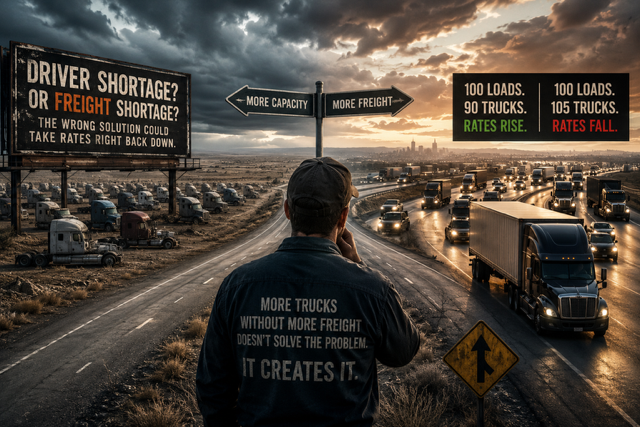
THE TRUCKING INDUSTRY MAY BE TRYING TO “FIX” THE VERY THING THAT IS FINALLY RAISING RATES
A Highway Fever Editorial
Sometimes trucking makes things far more complicated than they need to be.
So today, we’re going to do this Barney style.
No Wall Street vocabulary.
No economic degree required.
Just trucks, freight, drivers, and some very simple math.
Because J.B. Hunt and Schneider have recently told their shareholders something extremely important about the freight market.
And when you put their statements together, an interesting question appears:
If there isn’t enough freight to create a real freight boom, and rates are improving because trucking capacity has disappeared, why are we racing to put more trucks and drivers back into that same market?
Because if we succeed, we might already know what happens next.
Rates fall again.
FIRST, LISTEN TO WHAT THE COMPANIES ARE ACTUALLY SAYING
J.B. Hunt reported second-quarter 2026 revenue of approximately $3.50 billion, up about 19% year over year.
Operating income increased approximately 32%.
Earnings per share increased approximately 45%.
Those are impressive numbers.
But here’s where we have to pay attention.
Big corporate earnings do not automatically mean that America’s freight economy is booming.
Look underneath those numbers.
J.B. Hunt’s brokerage operation reported revenue per load up approximately 26%.
At the same time, purchased transportation expense increased approximately 54%.
Its truckload operation reported revenue per load excluding fuel up approximately 13%.
Yet the truckload operation still reported an operating loss.
That’s important.
Because if America were experiencing some massive freight boom, we should expect to see strong evidence of freight demand pulling the entire market upward.
Instead, much of what we’re seeing appears to be something different.
Capacity is getting tighter.
J.B. Hunt COO Nick Hobbs told investors that the driver market is clearly tightening.
The company is seeing signing bonuses increase in more locations.
Management doesn’t believe there is a quick solution to restoring capacity.
And J.B. Hunt expects highway capacity to remain constrained for some time.
Meanwhile, J.B. Hunt’s intermodal business is benefiting.
Intermodal volume increased approximately 10% during the quarter.
Why?
Because when highway trucking becomes expensive or difficult to secure, shippers start looking harder at rail and intermodal.
That’s not speculation.
J.B. Hunt itself has discussed the opportunity to convert more truck freight to intermodal as highway capacity tightens.
Now let’s walk across the street and listen to Schneider.
SCHNEIDER IS SAYING SOMETHING EQUALLY IMPORTANT
Schneider CEO Jim Filter recently said he does not expect freight demand to pick up sharply during the remainder of 2026.
Read that again.
Not a trucking critic.
Not some guy sitting in a truck stop.
The CEO of Schneider.
According to Filter, a significant improvement in freight demand would probably require meaningful changes in things such as inflation or interest rates.
Schneider isn’t presently expecting some dramatic improvement in either one.
Yet transportation prices are increasing.
Schneider says capacity has tightened because drivers and carriers have left the marketplace.
Dry-van spot rates were reportedly running roughly 39% higher year over year at the end of July, excluding fuel surcharge.
Now we have enough information to ask the question.
If demand isn’t exploding…
Why are rates climbing?
Pretty simple.
SUPPLY AND DEMAND
Imagine America has:
100 loads.
And America has:
90 available trucks.
Those 100 loads need to move.
But there are only 90 trucks available.
Now the shipper has a problem.
Several shippers may need the same truck.
What happens?
The truck becomes more valuable.
Carriers gain negotiating power.
Spot rates increase.
Contract rates eventually respond.
Brokers have to pay more to secure trucks.
That’s not a freight boom.
That’s a capacity shortage.
Now let’s “solve” the driver shortage.
We recruit drivers.
We offer signing bonuses.
We subsidize CDL schools.
We bring people into trucking.
We fill those empty tractors.
And instead of 90 trucks chasing those 100 loads, we put another 15 trucks into service.
Now America has:
100 loads.
And:
105 trucks.
Congratulations.
We solved the shortage.
There’s just one problem.
Now five trucks don’t have freight.
So what happens?
Carrier A wants the load.
Carrier B wants the load.
Carrier C wants the load.
Somebody eventually says:
I’ll haul it cheaper.
Then somebody else says:
I’ll haul it cheaper than him.
The shipper regains pricing power.
Brokers suddenly have plenty of trucks answering the telephone.
Tender rejection rates decline.
Spot rates weaken.
Contract negotiations change.
And eventually we’re right back where we started.
Too many trucks chasing too little freight.
Sound familiar?
It should.
Because trucking just spent several miserable years living through it.
THAT’S WHY WE NEED TO BE CAREFUL WITH THE WORDS “DRIVER SHORTAGE”
There may absolutely be a shortage of drivers that carriers can hire at the wages, schedules, working conditions and qualifications they currently require.
Those are legitimate operational problems.
J.B. Hunt itself is acknowledging tightening driver availability and increased signing bonuses in some markets.
But that’s different from saying:
America doesn’t have enough people holding CDLs to haul America’s freight.
Those two statements continually get mixed together.
A carrier having 200 empty trucks does not necessarily prove America needs another 200 drivers.
It proves that carrier wants 200 drivers.
Whether the freight economy actually needs those additional trucks is another question entirely.
And that’s the question trucking rarely asks.
LOOK AT WHAT HAPPENED DURING THE FREIGHT RECESSION
For years, trucking had too much capacity.
There were too many trucks competing for too little freight.
Rates collapsed.
Small carriers disappeared.
Owner-operators parked equipment.
Companies reduced fleet sizes.
Some carriers went bankrupt.
Other operators simply said enough is enough and walked away.
More recently, regulatory enforcement and licensing issues have removed additional operators or made it harder for certain drivers to remain in the market.
Whatever anyone thinks about the individual causes, the economic result is straightforward.
Capacity contracted.
And eventually something happened.
Rates started moving upward.
But here’s the distinction everyone needs to understand:
Rates can increase for two completely different reasons.
One is a genuine freight boom.
Factories produce more.
Consumers purchase more.
Construction increases.
Imports increase.
Manufacturing expands.
More freight enters the system.
The same number of trucks suddenly has considerably more freight to haul.
That’s demand-driven rate growth.
But there’s another way rates increase.
Freight stays relatively mediocre.
But thousands of trucks disappear.
Now the remaining freight has fewer trucks available to haul it.
That’s supply-contraction rate growth.
And based on what these companies themselves are telling their shareholders, today’s market appears to contain a significant amount of the second one.
Schneider was already describing what was happening as “structural supply rationalization.”
In its first-quarter results, Schneider’s revenue excluding fuel was actually down approximately 1% year over year.
Logistics revenue was down approximately 6%.
Its average truck count was also lower year over year.
And management continued pointing toward demand as the critical ingredient required for meaningful market improvement.
Again:
That’s not the picture of freight exploding across America.
It’s the picture of an industry whose supply side has finally begun correcting itself.
AND HERE IS WHERE THIS GETS REALLY INTERESTING
J.B. Hunt isn’t simply a trucking company.
It operates one of the largest intermodal networks in North America.
When highway capacity becomes scarce and truck rates increase, intermodal becomes increasingly attractive to shippers.
That’s good business for J.B. Hunt.
Again, that doesn’t mean J.B. Hunt is inventing a driver shortage.
It means we need to understand everyone’s position at the table when we’re listening to these conversations.
A highway capacity shortage can simultaneously hurt some portions of the transportation industry while creating opportunity for others.
And Wall Street understands that perfectly.
Truck drivers should understand it too.
NOW ASK THE QUESTION NOBODY SEEMS INTERESTED IN ASKING
Suppose the industry is right.
Suppose we desperately need drivers.
And suppose we succeed beyond our wildest dreams.
CDL schools fill up.
Carriers recruit thousands.
Government programs help train thousands more.
Signing bonuses work.
Empty tractors get drivers.
Capacity floods back into the marketplace.
Wonderful.
Now answer one question:
Where is the additional freight going to come from?
Because trucks don’t create freight.
Drivers don’t create freight.
CDLs don’t create freight.
Freight comes from economic activity.
Manufacturing.
Construction.
Retail.
Housing.
Imports.
Exports.
Consumer spending.
Industrial production.
If those things aren’t expanding fast enough to absorb the additional trucking capacity we’re creating, then we haven’t solved trucking’s problem.
We’ve recreated it.
That is why the economic comments coming from companies like Schneider matter.
If Schneider doesn’t expect freight demand to improve dramatically during the remainder of 2026, then adding substantial amounts of trucking capacity into that environment carries an obvious risk.
You’re increasing supply without significantly increasing demand.
And Econ 101 tells us what eventually happens.
Price falls.
In trucking, that price is the rate.
MAYBE WE SHOULD STOP CALLING EVERY RATE INCREASE A FREIGHT RECOVERY
Because those aren’t necessarily the same thing.
A freight recovery means freight demand is strengthening.
A rate recovery means the price of transportation is strengthening.
Sometimes they happen together.
Sometimes they don’t.
Right now, there is substantial evidence that trucking is experiencing a capacity correction alongside whatever modest changes are occurring in freight demand.
That’s an important distinction.
Because the policy response should be completely different.
If America truly has more freight than its existing transportation system can physically handle, then yes:
We need capacity.
We need drivers.
We need trucks.
But if America simply has fewer trucks competing for roughly the same mediocre freight environment, then flooding the market with new capacity could destroy the pricing improvement the industry just spent years waiting for.
SO HERE’S THE BARNEY VERSION
100 loads.
90 trucks.
Rates go up.
Recruit everybody we can find.
Fill every empty tractor.
Now:
100 loads.
105 trucks.
Rates go down.
Unless somebody can show us where those extra loads are coming from.
That’s it.
That’s the whole argument.
And before this industry spends billions of dollars recruiting, training, subsidizing and importing enough labor to refill every empty driver’s seat in America, maybe somebody should answer one very simple question:
How many trucks does the freight economy actually need?
Not how many trucks carriers own.
Not how many tractors are sitting against the fence.
Not how many drivers recruiters would like to hire.
How many trucks does the available freight actually require?
Because trucking has spent years complaining about terrible rates.
Capacity finally contracted.
Pricing power finally began moving back toward carriers.
And now we’re being told one of our biggest problems is that there aren’t enough drivers to put all that capacity back.
Think about that.
If we refill every empty truck while freight demand remains weak, we could accomplish something remarkable.
We could manufacture the next trucking recession before we’ve even finished climbing out of the last one.
Maybe the problem isn’t that America has run out of truck drivers.
Maybe the question is whether America currently has enough freight to support all the trucks the industry wants to put back on the highway.
Those are two very different conversations.
And it’s about damn time trucking started having the second one.
— Charles Claburn
Highway Fever