
Camp Soapbox | JR Elrod
Your Camp Counselor here.
Grab your coffee and pull up the nearest stump.
All right, campers…
Yesterday we left the Baltimore & Ohio Railroad with a problem.
They had built a road made of iron.
Now they had to figure out the best way to use it.
Hang on…
I need to adjust the Flux Capacitor.
WOOP… WOOP… WOOP… WOOP…
There.
1830.
Now things are about to get interesting.
Yesterday we watched America’s early railroad builders try just about everything.
Sail-powered railcars.
Horses walking on treadmills.
It sounds ridiculous today…
But nobody knew what the answer was.
They were experimenting.
Trying.
Failing.
Learning.
Sometimes progress looks a little ridiculous before it looks brilliant.
And while everyone else was trying to improve the horse…
One man had an entirely different idea.
His name was Peter Cooper.
Most people thought he was chasing an impossible dream.
Steam engines already existed.
But they were huge.
Heavy.
Expensive.
Most folks believed they’d break the rails before they ever hauled any freight.
Peter Cooper disagreed.
He believed a small steam locomotive could do what horses never could.
So he went into his little shop.
Started building.
Piece by piece.
Bolt by bolt.
Until one day he rolled out a little locomotive.
He called it…
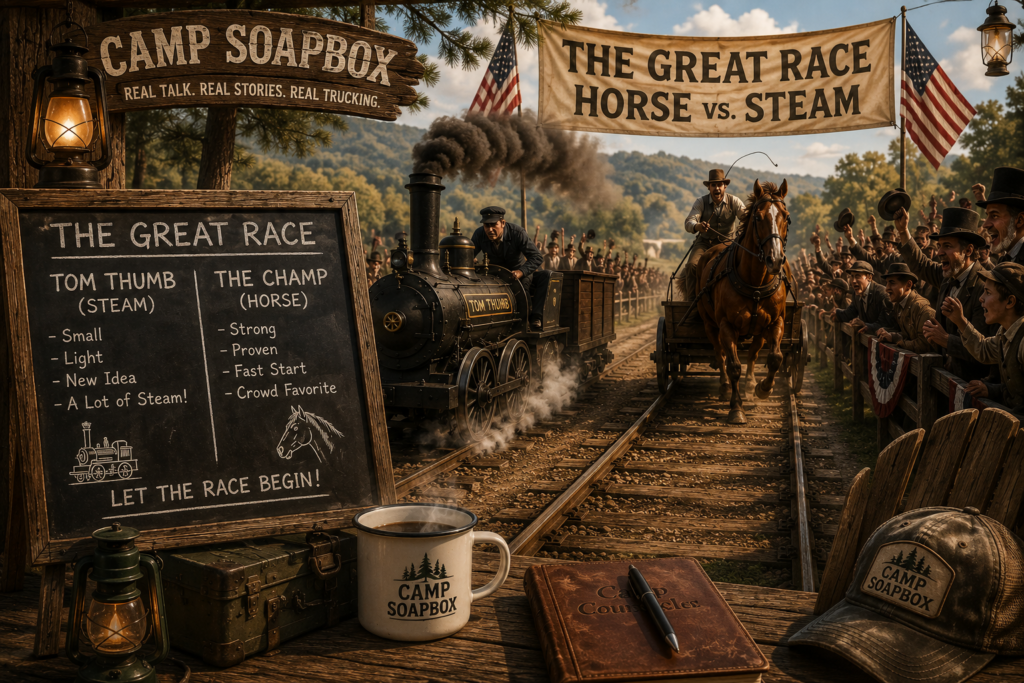
Tom Thumb.
Cute little name.
Tiny little locomotive.
Enormous idea.
As the story goes…
Somebody had another idea.
Let’s race it.
Horse…
Versus steam.
Can you imagine the crowd that day?
Farmers.
Merchants.
Railroad workers.
Children sitting on fence rails.
Everybody wanted to see if this noisy little iron kettle actually stood a chance.
The starter gave the signal.
The horse jumped out in front.
The crowd cheered.
Then the Tom Thumb began building steam.
Chuff…
Chuff…
Chuff…
Chuff…
Faster.
Faster.
Pretty soon…
That little locomotive pulled into the lead.
People couldn’t believe what they were seeing.
Then…
Disaster.
A belt driving the blower slipped off.
The fire lost its draft.
Steam pressure dropped.
The locomotive slowed.
The horse pulled back into the lead.
Officially…
The horse won the race.
But here’s the funny thing.
Nobody remembers the horse.
History remembers the little locomotive that lost.
Because everyone watching realized they had just seen the future.
Peter Cooper lost the race.
But he won the argument.
The future wasn’t blowing in the wind.
It wasn’t walking on a treadmill.
It wasn’t standing in a stable.
It was building steam.
Before we head back to our own time…
Think about our original question one more time.
What would America look like if trucks had never been invented?
Well…
Today we learned something important.
The railroad had finally found its engine.
But it still had one problem.
The tracks only went where the tracks went.
When that train stopped at the depot…
Guess who was still waiting?
Our old friend…
The waggoneer.
He loaded the freight.
Hitched up his horses.
And carried it the last few miles to the mill.
The general store.
The blacksmith.
The family farm.
Once again…
America had solved another piece of the transportation puzzle.
But only another piece.
Tomorrow…
We’re going to watch railroads spread across America.
And we’ll discover that even thousands of miles of iron rails couldn’t solve the last mile.
The waggoneer wasn’t going anywhere.
Not yet.
Until then…
I need to make one more adjustment to the Flux Capacitor.
Keep the coffee hot.
One last thing before I let you go…
My publisher keeps telling me I need to remind people I wrote a book.
Personally…
I think they’re just trying to justify their paycheck.
So…
Against my better judgment…
Here’s the shameless plug.
If you’ve been enjoying these little trips through history, I think you’ll enjoy Frozen Freight: Iron
Reach.
mybook.to/FrozenFreight
There.
The publisher is happy.
Now let’s go see what kind of trouble the Flux Capacitor gets us into tomorrow.