
Your Camp Counselor here.
Grab your coffee and pull up the nearest stump.
All right, campers…
Let’s move ahead about fifty years or so and see what’s going on with the transportation of goods.
Hang on…
I need to adjust the Flux Capacitor.
WOOP… WOOP… WOOP… WOOP…
Now we’re getting somewhere.
Yesterday we talked about the transportation problem.
Today we’re going to meet one of the men who tried to solve it.
Come here.
I want to introduce you to someone.
His name is DeWitt Clinton.
Most Americans have never heard of him.
That is a shame.
Because without him, the America we know today might look very different.
You see, by the early 1800s the country was growing faster than horses could keep up.
Farmers were producing more crops.
Merchants wanted larger markets.
Families were moving west.
Everybody wanted freight to move farther, faster, and cheaper.
There was only one problem.
The roads still looked a whole lot like the ones we rode on yesterday.
Then DeWitt Clinton came up with an idea.
“What if we built a river where there wasn’t one?”
People laughed.
A lot.
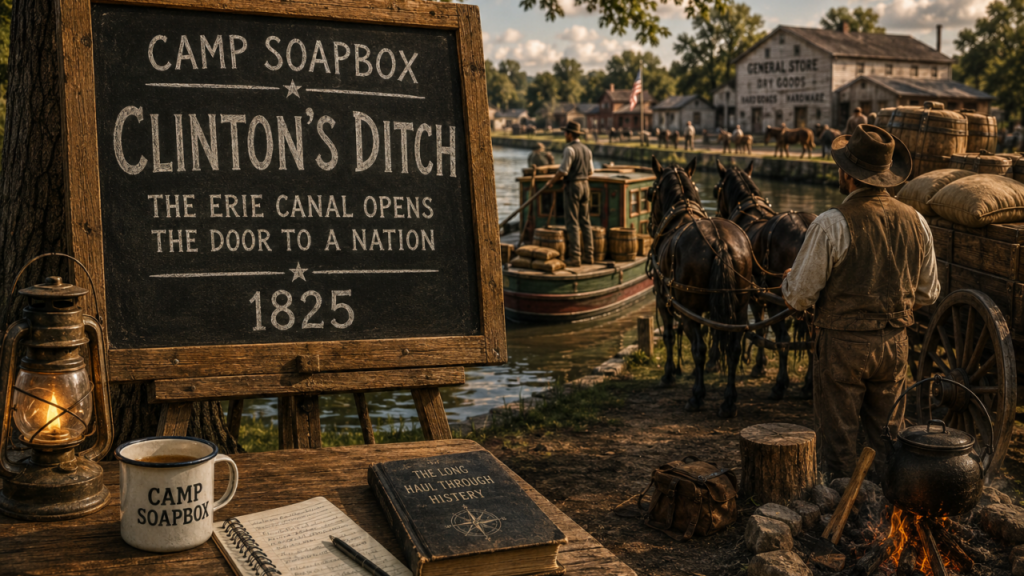
Newspapers called it “Clinton’s Ditch.”
Politicians mocked him.
Some people thought the whole idea was so ridiculous they believed it would bankrupt New York.
Think about that for a minute.
Today, if we want to dig a canal, we bring in bulldozers, excavators, laser surveying equipment, and diesel engines.
Back then…
They had shovels.
Axes.
Wheelbarrows.
Black powder.
Mules.
And thousands of determined workers.
Eight long years later…
The Erie Canal opened.
Three hundred sixty-three miles of man-made water connecting the Hudson River to Lake Erie.
Almost overnight…
Everything changed.
Before the canal, shipping a ton of freight across New York could cost around one hundred dollars.
After the canal opened…
About five dollars.
Read that again.
One hundred dollars.
Five dollars.
The freight didn’t change.
The wheat didn’t change.
The flour didn’t change.
The barrel didn’t change.
The only thing that changed…
Was how it got there.
Farmers suddenly had access to markets hundreds of miles away.
Merchants could stock goods that had once been too expensive to ship.
Settlements grew into towns.
Towns grew into cities.
New York City became the busiest port in America.
It all started because one man refused to believe the way things had always been done was the only way they could be done.
Now…
Come with me for just a minute.
Walk down to the edge of the canal.
There’s a canal boat easing past us.
The captain tips his hat as he glides by.
Behind him are barrels of flour.
Lumber.
Iron.
Salt.
Maybe a family heading west to start a new life.
For the first time in American history, freight is moving farther, faster, and cheaper than anyone thought possible.
Problem solved.
Right?
Not even close.
Because I want you to notice one very important thing.
That canal boat can’t leave the water.
It can’t deliver flour to the baker.
It can’t carry lumber to the carpenter.
It can’t take supplies to the family farm ten miles from town.
Somebody still has to move that freight after it reaches the dock.
And guess who is waiting there?
The waggoneer.
Most folks have never heard that word before.
Long before there were truck drivers, there were waggoneers.
They were the men who hauled America’s freight overland.
They didn’t have logbooks.
They didn’t have CB radios.
They didn’t have air ride seats.
What they had was a team of horses, a heavy wagon, and a long road waiting for them.
The canal boat could bring the freight to the dock.
But it was the waggoneer who delivered it to the blacksmith.
The general store.
The family farm.
The mill.
The baker.
Without him…
The journey wasn’t finished.
The farther we travel through history, the more obvious something becomes.
America wasn’t looking for one perfect way to move freight.
She was solving one problem at a time.
And every solution created another challenge waiting to be solved.
So before we head back to our own time, I want you to remember two men.
DeWitt Clinton.
The visionary who refused to accept that freight had to move the way it always had.
And the waggoneer.
The man waiting patiently at the dock to carry that freight the rest of the way.
Neither one could have done the job without the other.
So before you go about your day, think about our original question one more time.
What would America look like if trucks had never been invented?
Today you found part of that answer.
Canals could move freight.
Rivers could move freight.
But neither one could deliver it to your local grocery store.
Neither one could back up to the local hardware store.
Neither one could take lumber to the carpenter or flour to the baker.
That job still belonged to the waggoneer.
America had solved part of the transportation problem.
But only part.
Tomorrow, we’re going to make another jump through time and meet a machine that many people believed would replace the horse forever.
Iron rails.
Steam.
And another chapter in the story of how America learned to move freight.
Until then…
I need to make one more adjustment to the Flux Capacitor.
Keep the coffee hot.
One last thing before I let you go…
Over the last few days, I’ve devoted a lot of time to researching and writing this history series.
If you’ve been enjoying these little trips through time…
If you’ve liked my writing…
Can you imagine if I actually wrote a book?
…
Oh wait.
I did.
Yeah, I know.
That was completely shameless.
But hey… I’ve got to advertise my book somehow, right?
If you enjoy the way I tell a story around the Camp Soapbox campfire, I think you’ll enjoy Frozen Freight: Iron Reach.
It’s a suspense novel set in the world of heavy haul trucking, written by someone who’s spent nearly thirty years living it.
Take a look if you get a chance.
Frozen Freight: Iron Reach on Amazon
Now…
I’ll stop advertising and get back to adjusting the Flux Capacitor.
We’ve still got a lot of history left to explore.