
Camp Soapbox | JR Elrod
Your Camp Counselor here.
Grab your coffee and pull up the nearest stump.
All right, campers…
I hope you enjoyed our last stop.
We watched the world search for a new kind of power.
We saw steam prove that machines could move without horses.
We watched oil come out of the ground in 1859 and slowly change the way people thought about
energy.
We saw Nikolaus Otto build a practical internal combustion engine in 1876.
Then we watched Karl Benz put that idea on wheels in 1885.
The automobile was born.
But there was still one problem.
The automobile was built to move people.
America needed to move freight.
So let’s adjust the Flux Capacitor again.
WOOP… WOOP… WOOP… WOOP…
There.
Welcome to the 1890s.
Now look around.
This is not the quiet countryside we started in.
This is the city.
And folks…
It is a mess.
The same horse that built America was now becoming one of America’s biggest problems.
Cities depended on horses for almost everything.
They pulled wagons.
They moved supplies.
They delivered goods.
They carried people.
The entire city ran on horsepower.
Actual horsepower.
But every horse came with a cost.
It needed food.
It needed water.
It needed care.
And it created waste.
A lot of waste.
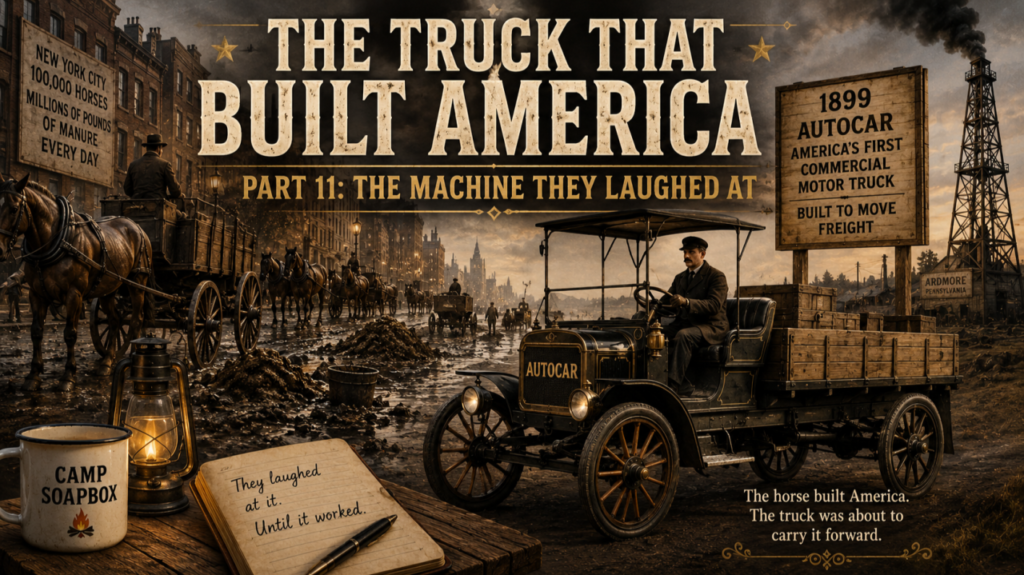
By the late 1800s, New York City had somewhere around 100,000 horses working its streets.
Those horses produced millions of pounds of manure every single day.
Think about that.
Every day.
The streets filled with it.
When it rained, it became a disgusting mess.
When it dried, dust filled the air.
Cities had a problem they could not solve.
And the craziest part?
They needed more horses to fix the horse problem.
More horses to haul feed.
More horses to haul supplies.
More horses to haul away the waste left behind by other horses.
The system that built America was starting to collapse under its own weight.
In 1898, leaders and planners gathered in New York City to talk about this growing problem.
They were looking for answers.
They did not find many.
Because to most people, the horse was permanent.
The horse had always been there.
The horse would always be there.
Or so they thought.
Because sitting off to the side was something most people were laughing at.
The motor vehicle.
And honestly?
They had a reason to laugh.
Those early machines were expensive.
They were loud.
They broke.
A lot.
People looked at them and said:
“That thing will never replace a good horse.”
And at the time…
They had a point.
But then something happened.
In 1897, a company called the Pittsburgh Motor Vehicle Company was created.
A couple years later, it would become known by another name.
Autocar.
And in 1899, in Ardmore, Pennsylvania, something happened that changed freight forever.
America got its first commercially available motor truck.
Now hold on.
Do not picture a Peterbilt.
Do not picture a Kenworth.
Do not picture chrome stacks, diesel smoke, and 80,000 pounds rolling down the interstate.
This little machine could haul around 700 pounds.
That’s it.
700 pounds.
Your pickup today would laugh at it.
It looked more like a strange little wagon than anything we would call a truck.
But it did something no horse could do.
It did not get tired.
It did not need hay.
It did not need a barn.
It did not leave behind a mess in the street.
And hidden inside that little machine was something bigger.
An idea.
The engine was placed under the seat to leave more room for freight.
Sound familiar?
That idea would eventually lead toward designs truck drivers still recognize generations later.
Because the mission never changed.
Make room for the load.
Move the freight.
Get the job done.
And remember that waggoneer we met back in 1776?
The person who fought the mud, the weather, the broken roads, and the distance?
He did not disappear.
He just changed seats.
He climbed down from the wagon…
And climbed into the truck.
Same job.
Same mission.
Different machine.
The horse built America.
The truck was about to carry it forward.
But there was still a problem.
This new machine was expensive.
Most working people could not afford one.
The truck existed.
But it had not reached the everyday American.
Not yet.
Because somewhere else, another man was looking at machines a little differently.
He believed they should not just belong to the wealthy.
He believed ordinary people should be able to own them.
His name was Henry Ford.
And he was about to change everything.
So next time, we adjust the Flux Capacitor again.
Because the truck has been invented.
Now America has to figure out how to put it in everybody’s hands.
Until then…
Keep the coffee hot.