
Camp Soapbox | JR Elrod
Your Camp Counselor here.
Grab your coffee and pull up the nearest stump.
All right, campers…
Earlier today we stopped for a minute and looked behind us.
We watched America grow.
We watched the waggoneer fight the mud.
We watched canals connect waterways.
We watched railroads stretch across the country.
And every single time America ran into a problem…
Someone looked around and asked a simple question.
What if there was a better way?
Well…
Hang on.
I need to adjust the Flux Capacitor.
WOOP… WOOP… WOOP… WOOP…
There.
Now this is interesting.
Before we can talk about the truck…
We have to talk about what made the truck possible.
Because nobody just woke up one morning, looked at a wagon, and said:
“Hey, let’s put a gasoline engine on that thing.”
No.
Like everything else we have seen on this journey…
It happened one step at a time.
And believe it or not…
The first step was steam.
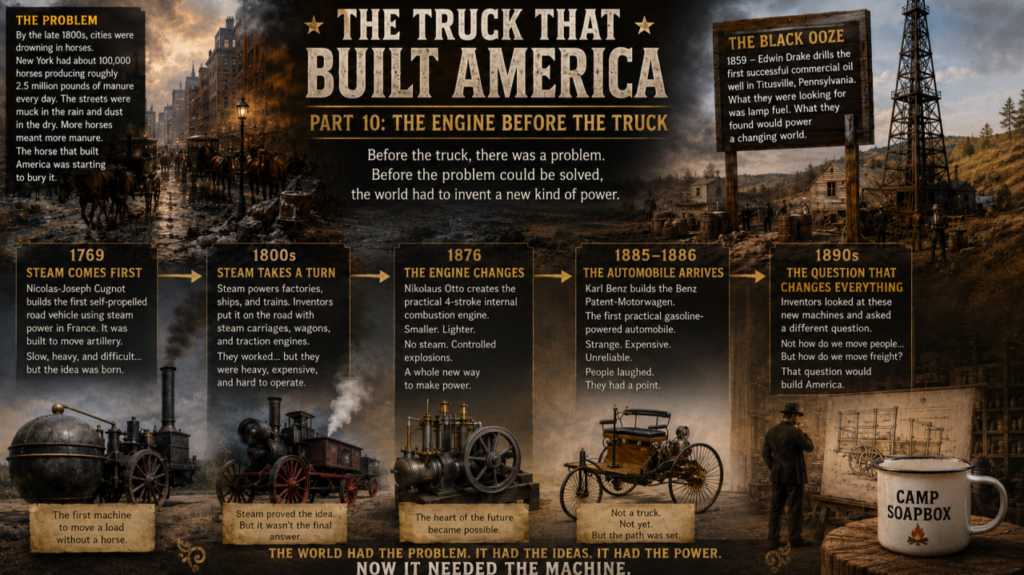
In 1769, a French inventor named Nicolas-Joseph Cugnot built something the world had never
seen before.
A vehicle that moved under its own power.
No horse.
No ox.
No animal pulling it.
Just a machine.
It used steam power and was designed to move heavy military equipment.
Now was it perfect?
Not even close.
It was slow.
It was heavy.
It was hard to control.
But remember something.
The first wagon was not perfect.
The first canal was not perfect.
The first railroad was not perfect.
Progress has never waited for perfect.
The idea was born.
A machine could replace muscle.
Through the 1800s, steam continued changing the world.
Steam powered factories.
Steam moved ships.
Steam pulled trains.
And naturally people asked:
Why stop there?
Why not put steam on the road?
So they tried.
Steam carriages.
Steam wagons.
Steam tractors.
And some of them worked.
But there was a problem.
Steam engines were heavy. They needed water. They needed fuel. They needed time to build
pressure before they could move.
Steam proved the idea.
But America needed something different.
Then something happened in Pennsylvania.
Titusville, Pennsylvania.
A man named Edwin Drake drilled the first successful commercial oil well in America.
Black liquid came out of the ground.
Now here is the funny part.
Nobody was standing there saying:
“Great, now we can build trucks.”
They were looking for lamp fuel.
Kerosene.
Light.
That was the money.
But that black liquid opened a door nobody fully understood yet.
Crude oil could be refined.
It could become different things.
And one of those things was gasoline.
At first gasoline was not the prize.
It was just something left over.
A product looking for a purpose.
It found one.
Because inventors were still searching for a better engine.
In 1876, a German inventor named Nikolaus Otto helped change everything with the practical
4-stroke internal combustion engine.
Instead of heating water to create steam…
The engine burned fuel inside itself.
Internal combustion.
Smaller.
Lighter.
Different.
The world was changing again.
Then came 1886.
Karl Benz introduced the Benz Patent-Motorwagen.
The first practical gasoline-powered automobile.
Now stop right there.
Do not picture the car sitting in your driveway.
This was not that.
It was strange.
It was expensive.
A lot of people laughed at it.
They said the same thing people always seem to say when something new appears.
“That will never replace what we already have.”
And honestly?
At the time…
They had a point.
The horse worked.
The horse was dependable.
The horse had carried mankind for thousands of years.
But something was happening.
The pieces were coming together.
The roads.
The fuel.
The engine.
The machine.
America had spent more than 100 years trying to move farther, faster, and better.
Now for the first time…
The bones of the truck existed.
It just wasn’t a truck yet.
Somebody still had to look at this new invention and ask a different question.
Not…
How do we move people?
But…
How do we move freight?
And folks…
That question changes everything.
Because next time we adjust the Flux Capacitor…
We finally meet the machine this whole journey has been leading toward.
Until then…
Keep the coffee hot.