
My mistake could save you from making the same mistake!
Ok folks, your Camp Soapbox counselor here.
Go get your fuel surcharge table. Seriously. Before you get too far into this, go find the thing. Print it out if you have to, because I have been hauling freight for thirty years, I have sent this table to shippers, argued rates off of it, billed off of it, and until Friday night I had never really sat down and taken the damn thing apart.
I wish I had.
Four weeks ago, during the week of August 17, my table provided no valid fuel-surcharge rate for any load I dispatched. Not because a broker refused to pay one. Not because I forgot to bill it. Because the number did not exist on my own table.
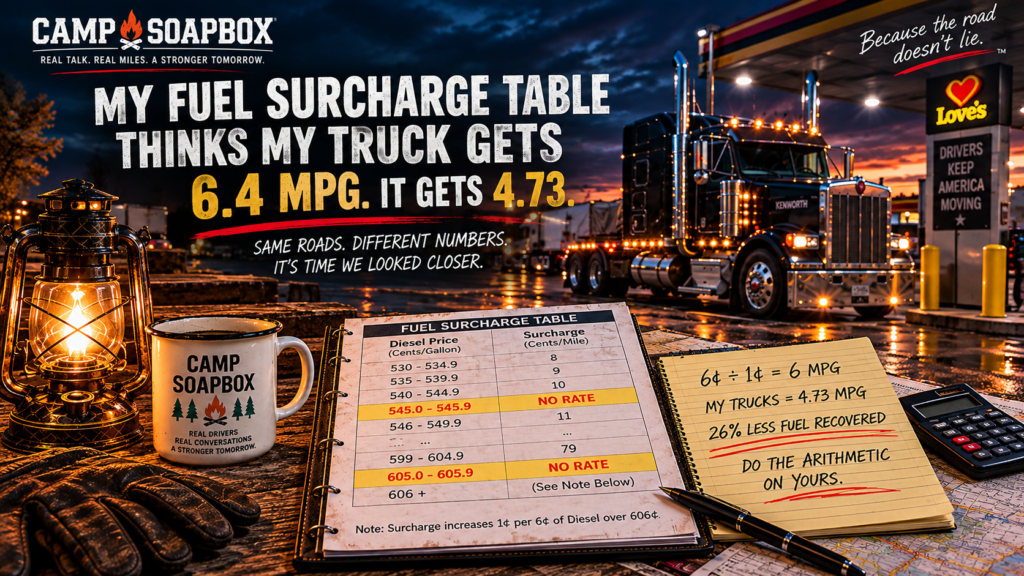
The Department of Energy national average that Monday was $5.454 a gallon. That is 545.4 cents. My table has a line for 540 to 544.9 cents, and the next one starts at 546. Nothing covers 545.0 through 545.9. There is a hole, and diesel landed right in the middle of it.
Then I found another one. My last printed row covers 599 to 604.9 cents and pays 79 cents a mile. Then the little note at the bottom takes over, and that starts at 606 cents. Nothing covers 605.0 through 605.9 either.
Another hole.
Diesel was knocking on the door of six dollars a gallon again this week. The September 7 DOE national average came in at $5.967, and some parts of the country were already over six bucks. Now, my table runs off the DOE Monday number, not whatever AAA says on Friday, so the number that actually matters for billing comes out Monday morning. It might land above that second hole. It might land below it. It might land right in the middle of the damn thing.
That is when I started wondering what else I had never noticed.
Turns out the holes were not the worst part.
Go grab two lines
Do not overthink this. Find two lines next to each other on your table and look at how much the diesel price moves. Then look at how much the surcharge moves.
On mine, through most of the working range, about every six cents of diesel gets me another penny per mile in surcharge. Six cents a gallon divided by one cent a mile works out to roughly six miles per gallon. Depending on where you are on my table, the number moves around a little. I get 6.67 in one section, about 6.38 around $5.40 diesel, and around 6.2 once you get into the extension over six bucks. Call it about 6.4 MPG across the working range.
Now here is where this got my attention. My trucks do not get 6.4 MPG. They averaged 4.73.
That is not something I pulled off Google. That is my own fleet, January 1 through September 12. My 2026 fuel report shows 54,530.59 gallons of tractor diesel purchased during that period. We do not run reefers, and there is no DEF mixed into that number. It is fuel that went into the trucks. When I divide those gallons by the corresponding IFTA jurisdiction miles from the same period, I get 4.73 MPG.
So every time diesel moves, this table is paying me for a truck that burns about 26 percent less fuel than mine actually burns.
Twenty-six percent.
Not in a bad week. Not because diesel spiked one Tuesday. Built into the damn table, every mile and at every price.
Now, maybe 6.4 works for somebody. It damn sure does not work for my operation. I haul step-deck and oversize freight. Heavy loads, wide loads, stuff sticking up in the wind. My trucks averaged 4.73, and that is the number that matters to me.
And here is the sneaky part
When I first found the last printed row, I thought I had found a cliff. I thought once diesel got past about $6.04, the table just stopped.
I was wrong, and I am going to be straight about that because the truth is actually worse.
The note at the bottom keeps the table going forever. Another penny per mile for roughly every six cents diesel climbs. Six-dollar diesel, seven-dollar diesel, eight-dollar diesel, ten-dollar diesel if the world loses its mind.
The table never breaks. It just keeps being wrong, and the dollar amount of the mistake keeps getting bigger.
Let me put that in regular English. The table starts paying at $1.03 a gallon. At six-dollar diesel, based on what my trucks actually burn, I need about $1.05 a mile for the fuel above that base. The table gives me about 80 cents. At seven dollars, I need around $1.26 and the table gives me 96 cents. At eight dollars, I need around $1.47 and the table gives me $1.12.
Every single dollar diesel climbs, I fall roughly another nickel a mile behind.
And there is no point where this table finally catches up. There is also no point where it breaks badly enough that everybody has to stop and renegotiate it either. That is almost worse, because the number on the invoice keeps getting bigger, so everybody looks at it and thinks the system is working.
It is not.
Now let me show you what a nickel here and a quarter there really means
At the September 7 DOE print of $5.967, my table pays 78 cents a loaded mile. The table’s base is $1.03 a gallon, so based on my actual 4.73 MPG, the fuel above that starting point costs me about $1.044 a mile.
I am short 26.4 cents every loaded mile.
Run that against 100,000 loaded miles and you get about $26,400. Using the unrounded numbers, mine came to $26,387.
Gone.
Not because somebody cheated me. Because I never checked the damn table.
I used actual fuel purchases and the corresponding IFTA miles from January 1 through September 12 of both 2025 and 2026. Then I compared what the table paid each year against what my trucks actually required at their real fleet MPG. A year ago the same table was short about 14.9 cents a mile, so the gap is not sitting still either.
Then deadhead takes another bite. The surcharge pays on loaded miles, but fuel burns on all of them. Right now I am running about 23 percent empty because I have a project loading out of Kansas and delivering to El Paso. There is not much coming out of El Paso that makes sense for us, so a lot of the time I am running back toward Dallas or Shreveport empty and starting over.
That is good freight and I am glad to have it, but a 78-cent loaded-mile surcharge does not magically stop the engine from burning fuel when the trailer is empty. Once I account for those miles, that 78 cents is really closer to 60 cents against the fuel I am buying.
And before somebody thinks I am telling you fuel surcharge tables are bad
I am not.
Hell, the bad table beat what happened on my broker freight.
Seventy-six percent of my loads this year did not use a published table at all. A broker gives you one number, and if you want to know what the fuel portion is, you back something out of it. Around here we use 15 percent and move on.
But that is not really a fuel surcharge. That is a bookkeeping entry.
Here is how I know. On my brokered freight, what I backed out as fuel went from 32.3 cents a loaded mile last year to 44.1 cents this year. Looks like it responded to diesel. It did not. My overall rates went up, and 15 percent of a bigger number is a bigger number. Diesel could have doubled with my rate staying flat, and that so-called fuel surcharge would not have moved one penny.
Now look at the one customer I haul for who actually uses a published fuel table. That surcharge went from 43.7 cents to 68.7 cents over the same period. Why? Because diesel moved. That table followed it.
A real table, even one with two holes and some screws loose, beat the percentage method by about 24 cents a loaded mile.
So no, I am not telling you to throw your table away.
I am telling you to go look at the damn thing.
What happens from here?
I ran three different scenarios. The government’s own EIA forecast says retail diesel averages about $5.55 in the fourth quarter. Fine. At $5.55, my table pays about 71 cents and my actual fuel requirement is about 95.6 cents. I am still short about 24.6 cents a mile.
Then I took the price movement from the last thirteen weeks and projected it forward at the same rate. That puts the fourth-quarter average somewhere around $6.90. At that price, I am short about 29 cents a mile.
Then I did the same thing using the steeper trend from the most recent nine weeks. If diesel keeps moving at that rate, it reaches roughly $7.51, and I am short about 32 cents a mile.
Those are projections, not predictions. I am not saying diesel will reach $7.51. I am showing what happens if the recent trend keeps going. I have already proven I can miss something sitting right in front of me on my own fuel table, so I am damn sure not claiming I can see three months into the future.
Do I think diesel is going to $7.51? I have no damn idea, and anybody who tells you they know exactly what diesel will do three months from now is either smarter than me or selling something.
Diesel went from around $3.81 to $5.64 in six weeks this spring, gave a bunch of it back by the Fourth of July, then turned around and climbed again. This thing has been up, down, sideways and backwards.
So pick whichever forecast you believe. I do not care.
I am short in all three.
That is the point.
Good case, bad case, holy-crap case. The table still does not match my trucks. That means this is not really a diesel forecasting problem.
You cannot outguess diesel, and neither can I.
This is a contract problem, and a contract problem can be fixed.
Then I kept looking
That was my mistake. Lol.
Once I saw the MPG problem, I started walking the whole table from top to bottom. That got interesting.
I found two holes. Two places where the surcharge stays the same while diesel goes up. One place where diesel goes up and the surcharge actually goes down a penny. Three lines cover the wrong price spread. One covers eight cents, two cover five, and most of the rest cover six.
And apparently 80 cents a mile does not exist in my world. The table goes from 79 straight to 81.
Then I read the fine print.
That did not help.
The escalation note says the surcharge goes up a penny for every 5.9-cent increase in diesel. Then the examples underneath it are six cents apart. Those are close enough if the examples are meant to be rounded illustrations, but they are not identical rules.
You follow 5.9 long enough and by eight-dollar diesel you are an entire line away from where the examples put you. Somebody is going to read that sentence literally one day, somebody else is going to read the examples, and now we get to spend an afternoon arguing over which one controls.
Then I checked the effective dates. The top of the table says Monday’s DOE rate applies to every load tendered that week. The bottom says changes take effect Wednesday after the Monday release.
Well, which is it?
Because Monday and Tuesday exist, and when fuel is climbing nine cents in a week, those two days are not nothing.
Then I got all the way to the footer. My table still says the current DOE average is $5.401 as of March 30.
I have been handing that thing to customers for five and a half months.
Yep.
That is on me too.
So here is the part I want every carrier to hear
I am not accusing anybody of cheating me. Hell, I think the truth is worse.
Nobody checked it.
Including me.
This is a document everybody in the chain treats like it came down from Mount Sinai on a stone tablet. The shipper sees it, the carrier sees it, accounting sees it, and everybody says yep, there is the fuel table.
Meanwhile, we are running businesses where two cents a mile matters.
The shipper probably is not going to find the problem. The broker is not going to find it. Your accounting software sure as hell is not going to stand up and tell you.
You are the one who has to find it.
So here is your homework. Go get your table and find two lines next to each other. Divide the diesel price step by the surcharge step and see what MPG your table is paying you for. Then pull your actual fuel gallons, pull your actual IFTA miles, and do the math.
If those two numbers are not close, you found a leak.
Then walk every line. Make sure nothing is missing. Make sure the surcharge never stays flat or goes backward when diesel climbs. Read the little note at the bottom that nobody ever reads. Check the effective dates. Check the footer.
Ten minutes might save you a hell of a lot more than ten minutes is worth.
Mine cost me about 26 cents a mile.
And I found it in a spreadsheet on a Friday night.
Go find yours.
End of transmission.