
By the Editorial Board
Highway Fever Media
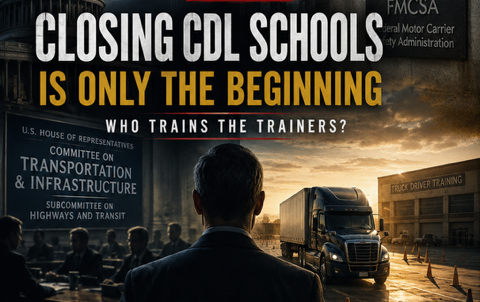
The recent crackdown on fraudulent commercial driver training schools is a welcome development. If a school is issuing credentials without meeting the standards required by law, it has no place to prepare tomorrow’s professional drivers.
Accountability matters.
Public safety demands it.
But removing bad schools from the system raises a larger question and one that deserves the same level of scrutiny.
What comes next?
Closing a school addresses one problem. It does not automatically solve the broader issue of how America’s commercial drivers are trained, who trains them, or whether the standards for becoming an instructor are producing the professionals this industry requires.
That conversation has received far less attention.
Every newly licensed truck driver learns from someone occupying the passenger seat. That instructor is responsible for more than teaching a student how to complete a pre-trip inspection, perform a coupling procedure, or pass a state examination. The instructor is responsible for developing judgment, professionalism, discipline, and the decision-making required to safely operate an 80,000-pound commercial vehicle.
Those qualities cannot be reduced to a checklist.
They are developed through experience.
That reality leads to several legitimate questions.
What qualifications must an individual meet before being entrusted to train future commercial drivers?
Who established those qualifications?
Are years of safe, over-the-road experience weighed as heavily as classroom credentials?
How are instructors themselves evaluated?
How often are those standards reviewed?
And perhaps most importantly, who is responsible for ensuring that the people teaching tomorrow’s drivers possess the experience, knowledge, and judgment necessary to prepare them for today’s highways?
These are not accusations.
They are questions that deserve answers.
The trucking industry has no shortage of regulations. It has no shortage of paperwork. What it has often lacked is an honest examination of mentorship.
A certificate may authorize someone to instruct.
It does not, by itself, make that individual a mentor.
The industry’s most respected professionals understand that experience cannot be condensed into a manual or captured entirely in a curriculum. It is earned through years of operating safely in mountain terrain, severe weather, congested cities, equipment failures, shifting freight markets, and the countless situations that never appear on a written examination.
Those experiences shape judgment.
Judgment saves lives.
The current enforcement efforts against fraudulent schools may prove to be an important first step. They should not, however, be mistaken for the final step.
If the objective is a stronger trucking industry and safer highways, the discussion cannot end at the classroom door. It must also examine the standards used to determine who is qualified to teach the next generation of professional drivers.
Closing schools may remove one weakness from the system.The greater opportunity may lie in taking a closer look at the standards governing the people seated beside every student before that student is ever trusted with the keys to an 80,000-pound truck.
Highway Fever Media Editorials represent the opinions of the Highway Fever Media editorial board. They are intended to encourage informed discussion on issues affecting the trucking industry through documented research, professional experience, and responsible journalism.