
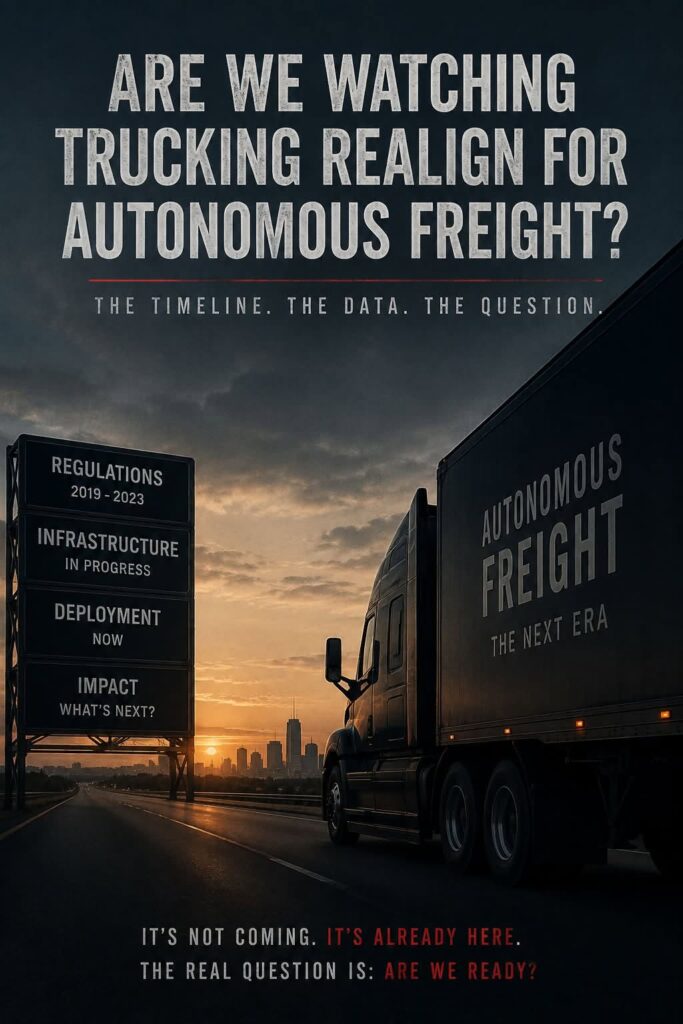
“Maybe the frog wasn’t dropped into boiling water. Maybe the temperature was turned up one degree at a time. One regulation. One inspection change. One infrastructure project. One workforce program. One leadership shift. And by the time everybody finally looked around, the water was already hot. The proof isn’t in one smoking gun. The proof is in the timeline.”
ARE WE WATCHING TRUCKING REALIGN FOR AUTONOMOUS FREIGHT?
Here is the theory I keep coming back to. Maybe these leadership changes are not random. Maybe they are not connected in some secret-room conspiracy either. Maybe what we are watching is something much simpler and much more believable: a realignment. An industry preparing the people, rules, infrastructure, technology, and institutions it thinks it will need for the next phase of freight. That is the question I want to ask: Is it plausible that the trucking industry is realigning itself for autonomous freight right in front of us? Not someday. Not twenty years from now. Now.
Before anybody starts yelling that this is Chicken Little saying the sky is falling, that is exactly what I am trying not to do. I am not telling anybody that an autonomous truck is coming for their job Monday morning. I am saying the technology is moving faster than a lot of drivers realize, the regulatory work has been taking place for years, manufacturers are now talking about hundreds and eventually thousands of trucks, and some very interesting people are moving into some very important positions. So instead of making an accusation, I want to put the pieces on the table and ask a question: Does the theory make sense? Because the farther back you go through the timeline, the more plausible it starts looking.
START WITH THE LEADERSHIP
This is actually what sent me down this road. Not autonomous trucks. Leadership. Look at the chairs that have changed or are changing.
Truckload Carriers Association President Jim Ward retired in April 2026, and his replacement is Jim Mullen. Mullen has one hell of a résumé for this particular moment in trucking. He is a former Acting Administrator of FMCSA and former Chief Counsel of FMCSA. He also has general counsel experience with a major publicly traded truckload carrier and later served as Chief Administrative and Legal Officer of a publicly traded autonomous-truck technology company. Now he is president of TCA. That does not prove an autonomous realignment, but if you were looking for somebody who understands federal regulation, trucking operations, Washington, and autonomous technology, that résumé checks a lot of boxes. SOURCE: Truckload Carriers Association, “TCA Chairman Karen Smerchek Announces Jim Mullen as New President,” February 9, 2026.
Then there is the American Transportation Research Institute. Rebecca Brewster announced in April 2026 that she will retire in early 2027 after decades with ATRI and 25 years leading it. ATRI did not wait until she walked out the door. Its board immediately began succession planning. Derek Leathers of Werner Enterprises chairs the ATRI board, and Brenda Neville of the Iowa Motor Truck Association chairs the search committee. The formal presidential search opened May 26, with applications due July 10. As of right now, no successor has been publicly announced. SOURCE: American Transportation Research Institute, “ATRI President Rebecca Brewster Announces Retirement,” April 20, 2026. SOURCE: American Transportation Research Institute, “Search for New ATRI President Commences,” May 26, 2026.
Why does that chair matter? Because ATRI sits right in the middle of freight data, carrier operations, technology, infrastructure, congestion, safety, and transportation research. That makes the background of the next person sitting in that chair worth watching very closely.
Then comes the one that started this entire conversation: Chris Spear and the American Trucking Associations. In May 2024, ATA’s board voted unanimously to extend Spear’s contract through 2029. ATA praised his leadership, strategic thinking, advocacy work, and ability to deliver for the organization’s members. SOURCE: American Trucking Associations, “ATA Extends President and CEO Chris Spear’s Contract Through 2029,” May 29, 2024.
Then comes a date that matters to this theory: June 9, 2026. Just a little over two months before Spear abruptly leaves ATA, he is still on Capitol Hill talking about the future of transportation technology. Among the issues he raises is autonomous vehicle development. Spear argues that the United States needs to maintain leadership in automated-vehicle technology and that Congress needs to provide a clear federal framework rather than allowing a patchwork of different state rules to develop. SOURCE: American Trucking Associations, Chris Spear testimony and Hill Report coverage of Senate Commerce Subcommittee testimony, June 9, 2026.
That date matters because it tells us something important. Spear was not sitting on the sidelines of the autonomous-trucking transition. He was publicly helping shape the policy environment around it. Then August 21, 2026 happens. Spear informs ATA’s Executive Committee that he is leaving effective immediately. Not at the end of the year. Not after a long transition. Immediately. ATA simultaneously tells its members that the organization has enough advocacy depth to continue without missing a beat, that its mission has not changed, and that its advocacy agenda remains intact. The search for the next president and CEO begins. SOURCE: FreightWaves, “Chris Spear departing as head of American Trucking Associations,” August 21, 2026. SOURCE: Trucking Dive, coverage of Chris Spear’s August 21, 2026 departure from ATA.
Does the June 9 testimony prove Spear’s departure was connected to autonomous trucking? No. It does not. But it makes the timing interesting. Because now the question is not whether Spear was involved in autonomous policy. He clearly was. The more interesting question becomes: If Spear was already helping shape that federal framework, what does ATA believe it needs from the person who comes next?
Maybe the next person has even deeper technology experience. Maybe infrastructure expertise. Maybe somebody closer to federal regulatory implementation. Maybe somebody with direct carrier-operations experience. Maybe none of those things. We do not know yet. That is exactly why the replacement matters. Chris Spear was never the ATA. He was the man standing in front of the machine. The lobbyists are still there. The policy staff are still there. The lawyers are still there. The state associations are still there. The committees are still there. The political relationships are still there. The institution keeps moving.
So I am not just watching who left. I am watching what skill set replaces him. Does the next ATA president come from traditional association management, or does that résumé include FMCSA, DOT, autonomous technology, infrastructure, connected transportation, data, carrier operations, or federal regulatory policy? That appointment may tell us more about what ATA believes the next decade of trucking looks like than Chris Spear’s departure ever will.
Women In Trucking has already gone through its own leadership transition. Founder Ellen Voie handed leadership to Jennifer Hedrick in 2023 following a planned executive search. I would not put that in the same category as Spear’s abrupt departure because it happened earlier and was planned. But it belongs on the broader leadership board because another longstanding trucking institution has moved into its next generation of leadership. SOURCE: Women In Trucking Association, “Jennifer Hedrick Named Incoming Women In Trucking Association CEO,” January 18, 2023.
So where does the leadership picture stand? TCA’s replacement is complete, and the person selected brings FMCSA, regulatory, truckload, and autonomous-technology experience. ATRI’s replacement is pending, so watch that résumé. ATA’s replacement is pending, and that may be the most important résumé to watch. Women In Trucking has already completed its generational transition. And sitting right in the middle of all of it is this little piece of timing: Chris Spear is publicly advocating a federal autonomous-vehicle framework on June 9, and on August 21 he leaves ATA effective immediately. That does not prove causation. It simply belongs on the board. Don’t just watch who left. Watch who they put in the chair.
NOW GO BACK TO 2019
In May 2019, FMCSA published an Advance Notice of Proposed Rulemaking on the safe integration of Automated Driving Systems-equipped commercial vehicles. FMCSA said it wanted to identify Federal Motor Carrier Safety Regulations that might need to be amended, revised, or eliminated to safely introduce autonomous commercial vehicles. ATA and the U.S. Chamber of Commerce Technology Engagement Center were involved enough in that proceeding that they jointly requested additional time to submit comments. SOURCE: FMCSA, “Safe Integration of Automated Driving Systems-Equipped Commercial Motor Vehicles,” May 28, 2019, Docket FMCSA-2018-0037. SOURCE: FMCSA, extension of the ADS comment period following a request from ATA and the U.S. Chamber Technology Engagement Center, July 2019.
Think about why that matters. The trucking rulebook was written around a human being. Part 383 deals with the commercial driver’s license. Part 391 deals with driver qualifications. Part 395 deals with hours of service. Part 396 deals with inspection, repair, and maintenance. Pre-trip inspections assume somebody is there to perform them. Roadside inspections assume somebody is sitting in the cab. Drug and alcohol rules assume a human operator. Cargo checks often assume a human driver. Before a driverless truck can operate at scale, somebody has to figure out what happens to rules that were written around the assumption that a driver is physically there.
FMCSA was openly asking those questions seven years ago. It specifically examined inspection, maintenance, pre-trip requirements, cargo checks, software, and how existing regulations should apply when Level 4 or Level 5 automation performs the driving task. SOURCE: FMCSA, Safe Integration of Automated Driving Systems-Equipped Commercial Motor Vehicles rulemaking materials, 2019. This did not start yesterday.
2021 — DOT PUBLISHES THE BROADER PLAN
In January 2021, the U.S. Department of Transportation released its Automated Vehicles Comprehensive Plan. Its major goals included promoting collaboration and transparency, modernizing the regulatory environment, and preparing the transportation system. DOT was openly discussing how government and industry would prepare for automated-vehicle deployment. SOURCE: U.S. Department of Transportation, “Automated Vehicles Comprehensive Plan,” January 2021.
Nobody had to uncover that. They published it.
2022 — CVSA ADDRESSES THE INSPECTION PROBLEM
Then comes inspections. How do you perform the traditional pre-trip and roadside inspection process when the truck may not have a driver? CVSA started answering that question. In 2022, the Commercial Vehicle Safety Alliance approved its Enhanced CMV Inspection Program specifically for commercial vehicles equipped with Automated Driving Systems. The program allows specially trained motor-carrier personnel to perform an enhanced inspection before dispatch, and inspection information can be communicated electronically so enforcement can know that the autonomous truck has passed the required enhanced inspection. CVSA specifically acknowledged that the existing roadside environment relies heavily on interaction with the human driver and that autonomous vehicles require a different approach. SOURCE: Commercial Vehicle Safety Alliance, “CVSA Announces New Enhanced CMV Inspection Program for Autonomous Truck Motor Carriers,” October 4, 2022.
Look at the progression. In 2019, the industry and regulators are asking how these vehicles will be inspected. By 2022, there is an inspection program designed specifically for them. It did not stop there either. Autonomous developers began participating in the program, and by 2026 companies were already discussing how inspection intervals and facilities could be made more efficient for commercial autonomous fleets. That is no longer an academic exercise. That is operational planning.
2023 — FMCSA COMES BACK TO LEVEL 4 AND LEVEL 5
In 2023, FMCSA returned with a Supplemental Advance Notice of Proposed Rulemaking. The agency continued examining the framework needed for Level 4 and Level 5 autonomous commercial vehicles, including trucks that could operate without a human driver onboard. SOURCE: FMCSA, Supplemental Advance Notice of Proposed Rulemaking, “Safe Integration of Automated Driving Systems-Equipped Commercial Motor Vehicles,” February 2023.
So by this point the progression is pretty clear. In 2019, the question is what regulations need to change. In 2021, DOT is talking about preparing the transportation system. In 2022, CVSA has an inspection system designed for autonomous commercial vehicles. In 2023, FMCSA is continuing the work of figuring out how Level 4 and Level 5 trucks operate when nobody is behind the wheel. That is not a prediction. That is a timeline.
2025 — DRIVERLESS CLASS 8 FREIGHT GOES COMMERCIAL
Then we stop talking about regulations and start talking about actual trucks. In May 2025, Aurora announced that it had begun regular commercial driverless freight operations between Dallas and Houston. Not a closed track. Not a computer simulation. Public highways. Class 8 trucks. Commercial freight. No human driver behind the wheel. SOURCE: Aurora Innovation, commercial driverless trucking launch announcement, May 2025.
That changes the conversation. The question is no longer whether a driverless Class 8 truck can move commercial freight. It can. The question becomes how quickly it can scale.
2026 AND 2027 — THE NUMBERS START GETTING BIGGER
Aurora says it expects to finish 2026 with approximately 200 driverless trucks operating commercially. Its manufacturing work with Roush is being ramped toward an annual production rate of approximately 1,000 autonomous trucks. SOURCE: Aurora Innovation, Q2 2026 Shareholder Letter. Two hundred trucks and manufacturing capacity moving toward a thousand per year is not mass replacement of the American truck driver tomorrow morning, but it is not a handful of science experiments either. Aurora has also discussed its longer-term opportunity in terms of eventually deploying tens of thousands of autonomous trucks. Those are their projections, not mine.
Then an operating fleet enters the picture. Aurora announced an agreement outlining a plan for Hirschbach to eventually own and operate 500 Aurora Driver-powered trucks, with deployments intended to begin in 2027. The operating model is important because the concept is not necessarily to remove the human driver from every mile. Autonomous trucks can handle longer highway segments while human drivers remain focused on shorter routes, more complicated freight movements, first mile, last mile, and work where human involvement remains necessary. SOURCE: Aurora Innovation and Hirschbach autonomous fleet announcement.
That should tell drivers something else. The first stage of autonomous trucking may not look like every driver disappearing. It may look like the job changing. Long-haul highway miles move toward automation while human drivers become concentrated in other portions of the freight network. That deserves a serious workforce conversation now, not after it has already happened.
Volvo Autonomous Solutions is moving as well. Aurora has reported that Volvo intends to begin driverless highway operations in 2027 and expects to exit that year with more than 300 driverless trucks, followed by larger industrial scaling. SOURCE: Aurora Innovation, Q2 2026 Shareholder Letter discussing Volvo Autonomous Solutions deployment plans. Again, that is 2027. Not 2040.
Daimler Truck owns Torc Robotics, and Torc says its autonomous Freightliner Cascadia is targeting commercial availability in 2027. Those trucks are already being tested on public roads as Torc moves toward commercial deployment. SOURCE: Torc Robotics, autonomous trucking commercial deployment and FAQ materials.
Put the manufacturer side together and the picture becomes difficult to dismiss as science fiction. Aurora already has commercial driverless freight moving. Aurora projects roughly 200 driverless trucks by the end of 2026 and is working toward manufacturing capability of roughly 1,000 annually. Hirschbach has outlined a 500-truck plan. Volvo is talking about more than 300 driverless trucks by the end of 2027. Torc and Freightliner are targeting commercial availability in 2027. Plans can change. Production can slip. Technology can have setbacks. Not every projection will necessarily be met. But these are the numbers the companies actually building and operating this equipment are putting in front of investors, customers, and the public.
REMEMBER ANDREW YANG
Back in 2019, Andrew Yang warned that autonomous trucking could begin seriously affecting truck-driving employment within roughly five to ten years. Do the math. Five to ten years after 2019 gives you 2024 through 2029. We are sitting in 2026, right in the middle of that window.
Yang also talked about managing the transition through retraining, new types of jobs, remote operations, and different roles for workers affected by automation. He even proposed creating a federal “Trucking Czar” to help manage that transition. SOURCE: Andrew Yang 2020 presidential campaign, “Trucking Czar” policy proposal, 2019.
That does not make Andrew Yang a prophet. It means the direction of travel was visible years ago.
Drivers themselves have been raising the workforce question too. Will Cook and A Driver’s Perspective have been asking what happens to the human driver while technology, government policy, and corporate capital continue moving ahead. That is not fearmongering. That is a workforce question, and somebody had better be asking it while there is still time to shape the answer.
WORKFORCE TRAINING MATTERS TOO
Look at major companies. FedEx has publicly discussed autonomous technology creating new training and career opportunities for employees. Walmart has invested heavily in internal training, education, and future-workforce skills. UPS operates major workforce-development and education programs. I am not saying those programs were all created specifically because autonomous trucks are coming. They were not. But if you were a giant corporation preparing for a technological change in how freight gets moved, what would you do? You would train people, reskill people, create technical positions, develop new operational jobs, and prepare employees for a different freight network. That is what a managed transition looks like.
THEN THERE IS INFRASTRUCTURE
Autonomous freight has never only been about building the truck. Studies and industry planning have discussed transfer hubs, connected roads, roadside communications, inspection facilities, parking, freight corridors, digital systems, and other infrastructure needed to make these operations work at scale. Today we are spending billions modernizing freight infrastructure through truck parking, intelligent transportation systems, connected transportation, freight corridors, inspection technology, and other projects.
Does that mean every truck parking project is secretly being built for autonomous trucks? No. That would be nonsense. But it does mean we should start reading the whole project description instead of just the press release. That is one of the reasons Highway Fever Media started From Authorization to Asphalt. We were already asking where the money is going, what was authorized, what was actually obligated, what has gone to construction, where the finished spaces are, and where the asphalt is.
Now there may be another question worth adding: What else is being built into these freight corridors while everybody is focused on the parking-space headline? Connected systems? Inspection technology? Communications? Transfer capability? Infrastructure that can serve both today’s human-driven trucking industry and tomorrow’s autonomous freight network? That is worth investigating, not because we already know the answer, but because we ought to be asking the question.
COME BACK TO THE REALIGNMENT THEORY
This is where all of it comes back together. Autonomous trucking is not just a technology story anymore. It is a regulatory story, an inspection story, an infrastructure story, a workforce story, a political story, and maybe now a leadership story.
TCA replaces its president with a man whose résumé includes FMCSA and autonomous-truck technology. ATRI is choosing a new president. ATA suddenly needs a new president and CEO despite Chris Spear previously being extended through 2029. Just over two months before Spear leaves, he is still in Washington publicly advocating a federal framework for autonomous vehicles. Manufacturers are moving toward commercial scale. FMCSA has spent years working through regulations originally written around a human driver. CVSA has already created an inspection system for autonomous trucks. The federal government has been publicly talking about preparing the transportation system for automation since at least 2021.
That is why I keep coming back to the same question: What kind of people are these institutions going to choose to lead the next phase? Do not just watch who left. Watch who they put in the chair.
If the next ATA president comes out of autonomous technology, FMCSA, DOT, infrastructure, data, connected freight, or carrier operations, pay attention. If ATRI makes a similar choice, pay attention again. One appointment could be coincidence. Two could still be coincidence. But if the skill sets continue moving in the same direction, at some point it becomes reasonable to ask whether the institutions themselves are positioning for a different era.
THERE ARE ALSO FIVE BIG PROBLEMS THEY HAVE TO MANAGE
If autonomous freight is going to scale nationally, there are several obvious obstacles. One is CDL integrity and the political fight over foreign drivers, non-domiciled CDLs, visa programs, licensing standards, and enforcement. Those issues are politically explosive right now. It is a midterm election year, drivers are angry, and the public is paying attention. You cannot successfully sell the American driver on a new freight future while that driver believes the current labor system is already working against him. That issue has to be stabilized.
Then there are visible benefits for today’s driver. You cannot spend billions talking about smart highways and connected freight while today’s driver still cannot find a place to park. Truck parking matters. Rest areas matter. Roads and bridges matter. The human driver has to see some benefit from the modernization taking place around him.
Workforce fear may be the biggest obstacle of all. You cannot tell millions of working Americans, “We are modernizing the freight network so eventually we need fewer of you,” and expect them to embrace it. The industry has to explain what happens to the workforce. What jobs remain? What jobs change? Who gets retrained? What happens to long-haul drivers? Who handles first mile and last mile? Who works in remote operations? Who maintains these systems? Those questions are coming whether anybody wants to answer them or not.
Federal uniformity matters too. Autonomous freight does not scale easily if every state creates a completely different regulatory system. Texas cannot have one operating framework, Arizona another, California another, and Pennsylvania another and expect a national autonomous freight network to operate efficiently. That is why the fight over federal standards and preemption matters.
Finally, there is public acceptance. Nobody is going to Washington and saying, “Give us billions so corporations can get rid of truck drivers.” The argument will be about safety, efficiency, congestion, supply-chain resilience, modern infrastructure, American technology leadership, stronger enforcement, and better freight movement. Those can all be legitimate goals. But they also happen to be the kinds of things that make large-scale autonomous freight possible.
And that is something drivers need to understand. Two things can be true at the same time. Infrastructure can genuinely help today’s driver while also preparing for tomorrow’s technology. A regulatory change can solve today’s problem while also removing an obstacle to automation later. That is not necessarily sinister. It is how large technological transitions happen.
LOOK AT THE BOXES
Regulations are being addressed. Inspections are being addressed. Infrastructure is being modernized. Federal standards are being pursued. Workforce systems are being changed. Autonomous trucks are already hauling commercial freight without a driver. Manufacturing capability is increasing. Leadership is changing.
Does that prove somebody sat in a room and coordinated every piece? No, and I am not going to tell you that it does. Does it prove Chris Spear was removed because of autonomous trucking? No. Does it prove every highway project is part of an autonomous freight network? No.
But does it make the broader theory of an industry realigning itself for autonomous freight plausible?
I think it does.
That is why drivers need to pay attention, not panic. Read the regulations. Read the infrastructure plans. Watch the manufacturers. Watch the production numbers. Watch the legislation. Watch the money. Watch the leadership appointments. Most importantly, watch who replaces the people leaving.
Maybe Chris Spear leaving is not the story. Maybe it simply caused us to finally look at something that has been moving in front of us for years. Maybe the real question is no longer, Are autonomous trucks coming? They are already here. The better question is: How much of the system required to scale them has already been put in place while drivers were still arguing over whether they were coming at all?
That is where the timeline becomes so important. Maybe the frog was indeed boiled slowly. Not all at once. One regulation, one inspection change, one infrastructure project, one workforce program, one autonomous deployment, one leadership change, one degree at a time. And by the time everybody finally looks around, the water is already hot.
There may never be one smoking gun. There may never be one memo that explains the whole thing. Maybe there does not need to be.
The proof is in the timeline.
So I will leave you with the question I started with: Are we watching the American trucking industry realign itself for autonomous freight right in front of us?
I cannot prove that yet. But after looking at the timeline, the federal rulemaking, the inspection changes, the infrastructure, the manufacturers’ own deployment numbers, Chris Spear’s June 9 testimony, and the leadership moves taking place across major trucking institutions, I can tell you this:
It is plausible.
And it is moving way too fast for truck drivers to keep treating it like science fiction.