
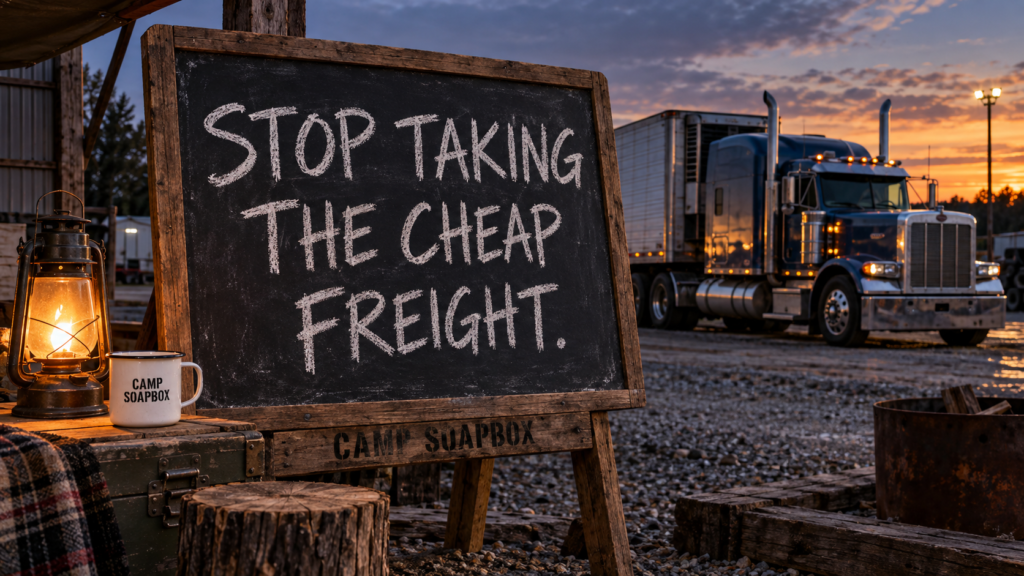
Stop Taking the Cheap Freight
Ok folks, your Camp Soapbox counselor here.
A STRIKE IS NOT A PLAN
Ok folks, your Camp Soapbox counselor here.
I was watching a video by Charles Claburn on Facebook this morning about the truck shutdown people are calling for, and I think Charles says it better than most of the people talking about it. Before you read the rest of this, take a few minutes and watch his video. Whether you agree with every word or not, he raises questions this industry needs to answer before anybody starts telling truckers to park their equipment.
His video is what sent me down this road because he did something the social-media shutdown crowd has not done enough of. He looked backward before telling everyone to charge forward. He brought up the truck shutdowns of the 1970s, reminded people that not every truck stopped and asked what those shutdowns actually changed over the long term. That is the right place to start this conversation.
Listen, folks, this article is long for a reason. It is important. If you are looking for three sentences, a picture of an angry trucker and somebody yelling SHUT THEM DOWN, this is not going to be that post. This is about what a shutdown would actually require, why previous shutdowns did not permanently fix the industry, why different parts of trucking are not fighting the same financial battle and what independent carriers can do right now without waiting for somebody on Facebook to save them.
Charles made several good points, including one that ought to make all of us stop, put our emotions aside for a few minutes and look at what history has already taught us. Truckers tried this before. The independent truckers who shut down in the 1970s brought national attention to fuel prices, operating costs and the financial pressure on small carriers, but not every truck stopped and the changes they won did not permanently solve the problems.
The 1974 shutdown resulted in some real concessions. The federal government froze retail diesel prices, made changes involving fuel availability and allowed carriers to recover part of their increased fuel expense through a temporary surcharge. Another shutdown in 1979 contributed to changes in the fuel-surcharge program. Those truckers did not go home completely empty-handed, and it would be dishonest to say they accomplished nothing.
However, it would be equally dishonest to pretend those shutdowns repaired the industry. Roughly fifty years later, truckers are still fighting about fuel prices, cheap freight, broker practices, unpaid waiting time, insurance expenses, government regulations and the inability of small carriers to recover rapidly increasing operating costs. That does not mean those truckers were wrong to fight. It means temporary concessions and permanent structural change are two very different things.
A shutdown is not automatically a plan
I am not against a legitimate, properly organized shutdown. If somebody develops a real plan with clear demands, responsible leadership, legal guidance, financial preparation and a person or organization authorized to negotiate, I will listen. If that plan gives carriers a better-than-average chance of producing lasting change, I would seriously consider parking my trucks with everyone else.
What I will not do is park four trucks because somebody created a Facebook graphic, selected a date and wrote SHUT THEM DOWN in capital letters. That is not organization. It is not a negotiating strategy, and it does not explain what happens to the carrier after the cheering stops and the payments keep coming.
Before anyone asks carriers to stop operating, somebody needs to answer several basic questions. We need to know exactly what the demands are, who has the authority to negotiate, how long the shutdown is supposed to last, what determines whether it succeeded and how participating carriers will survive financially while their trucks are parked. We also need to know what happens if shippers, brokers and the government simply wait for truckers to run out of money.
A real strike needs more than a starting date. It needs leadership, specific demands, broad participation, legal advice, financial support and an ending. Most importantly, it needs a plan for what happens after the trucks start moving again. Without those things, we do not have a strike. We have a social-media event that may leave already struggling carriers in even worse financial condition.
Most owner-operators cannot afford a long shutdown
Here is the truth that hurts. Many owner-operators and small carriers do not have enough money saved to survive a long shutdown. Some have been beaten half to death by weak freight rates, high fuel prices, insurance renewals and repair bills. Others failed to build a reserve when business was better. There are also people who entered this industry without enough capital from the beginning because somebody convinced them that owning a truck automatically meant they owned a successful business.
Regardless of how they got there, the result is the same. The truck payment does not stop because the truck is parked. The insurance company still wants its premium, the driver still needs a paycheck, the shop still expects to be paid and the finance company will not accept industry solidarity in place of money.
Meanwhile, many manufacturers and shippers can delay freight longer than an owner-operator can delay a truck payment. Some have inventory available. Some can move products by rail, delay production or wait for enough trucks to return. Large corporations also have access to money and credit that a one-truck operator does not have.
Then we need to think about what happens when financially desperate carriers return to work. Freight that was delayed during the shutdown may be sitting there, but so will a large number of trucks whose owners need immediate cash. When too many trucks chase the same loads, carriers begin bidding against one another. Instead of forcing rates higher, an unplanned shutdown could create another short-term race toward the bottom as people accept almost anything to restart their cash flow.
Those carriers would lose revenue while parked, return to work with bills stacked on the desk and begin fighting over freight because they need money immediately. We should ask ourselves what that actually wins. A shutdown without a financial support system, recognized leadership and a negotiating strategy could injure the same independent carriers it claims to protect.
Not everybody behind the wheel is fighting the same battle
Another weakness in the nationwide-shutdown argument is the assumption that everybody driving a truck has the same financial reason to stop. We do not.
Company drivers have legitimate complaints about pay, home time, unpaid detention, equipment and the way some dispatchers and customers treat them. A driver can lose an entire day sitting at a dock and receive little or nothing for that time. Those are real problems, and company drivers have every right to demand better treatment.
However, most company drivers are paid by the mile, load or hour and receive a reasonably predictable paycheck. If freight slows down, it can reduce their miles and income, but they are normally not responsible for the truck payment, trailer payment, insurance, fuel, permits, tires and major repairs. A company driver may support a shutdown because of working conditions or pay, but the financial calculation is different from the one facing the person who owns the equipment.
Contractors leased to established carriers also have legitimate complaints. Fuel prices and weak freight rates hit them, and some were sold the dream that they could buy a truck, lease it to a company and become independent. How independent some of those contractors really are is a subject for another article, but many have access to a carrier’s customers, freight network, fuel discounts, billing system and administrative support.
A leased contractor does not have guaranteed income, and plenty of them are struggling, but that situation is still different from a true independent carrier trying to find, negotiate and price every load on the open market. The independent carrier has to locate the freight, investigate the broker, negotiate the rate, buy the fuel, pay the insurance, maintain the equipment, cover every empty mile and then wait to be paid.
That is where the current freight market cuts the deepest. Everyone involved in the shipment knows what the transaction needs to produce for their own company. The shipper protects its costs and profit, the broker protects its margin, the insurance company protects its revenue and the attorneys know what they intend to collect. The only person regularly told to forget about making a profit is the one supplying the equipment, assuming the liability and physically moving the freight.
Everybody has an organization, but nobody represents everybody
Look at the number of organizations serving different parts of trucking. We have the Owner-Operator Independent Drivers Association, the American Trucking Associations, the Truckload Carriers Association, the National Association of Small Trucking Companies, Women In Trucking, state trucking associations and numerous specialty organizations.
Some of these organizations do useful work. They provide legal assistance, education, research, discounts, lobbying and information that carriers genuinely need. I am not going to claim every association is useless just because it cannot repair the entire industry. That would not be fair or accurate.
The problem is that every association has its own membership, priorities and agenda. ATA does not represent exactly the same interests as OOIDA. A thousand-truck fleet does not face the same problems as a one-truck carrier. A private fleet, a household-goods mover, a company driver, a leased contractor and a true independent may all be part of trucking, but they are not operating under the same financial pressures.
That is one of the reasons trucking has such a difficult time speaking with one voice. Before we decide what the solution is, we cannot even agree on the problem because the problem changes depending on where someone sits.
Then we have resources like WeTheTruckers.com. People built the website, gathered information and found experienced people willing to write about the problems facing this industry. They made information available to drivers and owners who need help understanding costs, rates, regulations and business decisions. Much of that material is available without charging anyone simply to read it.
The frustrating part is that this industry has associations, experienced owners, websites, calculators, articles and decades of hard-earned knowledge available, but many operators will not use any of it. Some will spend hours arguing online about what a broker made on a load but will not spend thirty minutes calculating what their own truck costs per mile.
Sit down, shut up and watch me fail
Why do people refuse information that might help them survive? In many cases, the explanation comes down to a few words that have probably helped put more owner-operators out of business than any broker ever did: I do not need help because I already know what I am doing. The complete version might as well be, “Sit down, shut up and watch me fail.”
That attitude is everywhere in trucking. There are operators who genuinely understand their businesses. They know their costs, maintain adequate reserves, take care of their equipment, price their freight correctly and prepare for the bad months. Those people exist, and some have built successful companies by combining trucking knowledge with business discipline.
Far too many others know how to drive a truck and assume that means they know how to operate a trucking company. Those are not the same job. Being able to back into a difficult dock does not teach someone cash flow. Pulling an oversize load does not teach anyone how to read a profit-and-loss statement. Knowing how to shift eighteen gears does not tell an owner whether a $2.10-per-mile load is producing a profit or quietly putting the company out of business.
Some operators cannot state their actual cost per mile. They do not know how much money needs to be reserved for tires, maintenance and replacement equipment. They accept a rate based on whether it will cover today’s fuel and next week’s truck payment while ignoring every expense that is not demanding immediate payment.
That is how someone can stay busy and still go broke. The truck keeps moving, revenue keeps entering the bank account and the owner believes the business is surviving. In reality, he may be using his maintenance reserve, replacement-equipment money and future tax payment to subsidize someone else’s shipment.
Eventually, the deferred expense arrives. An engine fails, a tire blows, the insurance premium increases or a customer pays late. The business does not collapse because of one repair. It collapses because the freight hauled before that repair never produced enough money to prepare for it.
The bankruptcy count does not show the entire failure
During the first half of 2026, at least 64 freight and trucking-related companies formally filed for bankruptcy. Industry reporting identified 38 filings during the first quarter and another 26 during the second quarter. Additional carriers have filed during the third quarter, but a complete July-through-September count is not yet available.
Even that number does not show the full amount of failure taking place in trucking. Bankruptcy is a court filing, while a business failure is a company that can no longer continue operating. Those are not the same number.
One-truck operators and very small carriers often disappear without filing a business bankruptcy. Some surrender or sell the truck, voluntarily revoke their authority, allow their insurance to lapse, close the LLC, lease onto another carrier or file personal bankruptcy because they personally guaranteed the company’s debts. Those failures may never appear in a report about trucking-company bankruptcies.
FMCSA authority revocations do not give us a clean answer either. Authorities are revoked for multiple reasons, including insurance cancellations, voluntary closures, administrative problems, mergers and temporary exits from the market. We cannot honestly call every revoked authority a bankruptcy.
What we can say is that at least 64 freight and trucking-related businesses entered formal bankruptcy during the first six months of this year, while an unknown number of one-truck and small carriers quietly left the industry without appearing in that count. The true number of failed trucking businesses is almost certainly higher than the number we can document through bankruptcy court.
Those disappearing carriers are not all victims of one cause. Some were damaged by weak rates, fuel prices, insurance costs, dishonest business practices or catastrophic repairs. Some were undercapitalized from the day they bought the truck, and others never understood what their freight needed to pay. In many cases, several of those factors worked together until there was no money left.
This is exactly why telling everyone to park their truck without a financial plan concerns me. Many independent operators are already one major repair, one missed payment or one blown tire away from forced retirement. Parking the truck may make a statement, but statements do not pay creditors.
Stop taking the fucking cheap freight
If we are not prepared for an organized national shutdown, where can independent carriers begin fighting back? We can start by knowing exactly what it costs to operate our own equipment and refusing freight that does not cover that cost and produce a reasonable profit. In plain English, stop taking the fucking cheap freight.
That does not mean carriers should get together and establish one industry-wide minimum rate. Every company has different equipment, debt, insurance, lanes, customers and operating expenses. My required rate may not be your required rate, and agreements among competing businesses about prices can create serious antitrust problems.
What I am saying is that every carrier should independently calculate its own operating cost, determine the profit required to keep the business healthy and refuse loads that do not meet that company’s needs. That does not require a nationwide strike, a union or permission from somebody on Facebook. It requires enough knowledge to recognize a bad load and enough discipline to walk away from it.
Most people would not accept a job for minimum wage if they possessed thirty years of specialized experience and carried millions of dollars in responsibility. Most would not knowingly pay twice what a car was worth. However, owner-operators accept freight below the true cost of operation every day because the offer puts enough cash in the account to solve an immediate problem.
When that happens, the owner is not buying himself a job. He is financing somebody else’s shipment with his truck, fuel, maintenance money and future. The load moves, the customer learns that someone will haul it for that rate, and the next carrier is expected to match or beat it. The race toward the bottom takes another lap.
The broker will protect the brokerage, the shipper will protect the shipper and the insurance company will protect the insurance company. None of them started businesses as public services, and neither did we. Independent carriers have to start protecting their companies with the same determination everyone else uses to protect theirs.
Pride is one of the most expensive things in trucking
If an operator is unwilling to ask for help, learn the numbers and make the difficult decisions required to build a successful company, that person needs to stop blaming everyone else for every result. Cheap freight, high insurance, fuel prices, dishonest brokers and abusive lawsuits are real, but refusing to learn the business is real too.
Put your pride on the shelf and listen to people who have spent thirty years doing this. More importantly, listen to the experienced people willing to admit that they have failed.
I have made mistakes. I have taken freight I should have refused, trusted numbers I should have checked and made decisions that cost money. Some lessons were cheap, while others cost enough to ensure I remembered them.
Experience does not mean never failing. Experience means figuring out why you failed, correcting the problem and refusing to pay for the same lesson twice.
The information is available, and some of it costs nothing. Experienced people are willing to help, but nobody can force another business owner to use that information. If someone refuses every offer of help because pride will not allow an admission that there are things left to learn, then that person needs to stop complaining while driving the business into the ground.
At some point, refusing to learn becomes a choice. The consequences of that choice do not automatically become everybody else’s fault.
What would a real shutdown require?
A properly organized shutdown would begin with clear and achievable demands. Those demands could involve broker transparency, detention compensation, fuel-surcharge practices, insurance reform or other specific issues, but participants would have to agree on what they were asking for before anyone parked a truck.
The movement would need recognized leadership with enough credibility to speak for participating carriers. It would require legal guidance so independent businesses did not stumble into antitrust violations or expose themselves to other unnecessary liability. It would need a financial support system because carriers without reserves cannot remain parked indefinitely.
Organizers would also need honest estimates of participation. A strike involving a fraction of independent carriers while most company fleets, private carriers and leased operators continue moving freight may attract attention without producing enough pressure to force negotiations.
Finally, the shutdown would need an exit strategy. Participants would need to know what constitutes an acceptable agreement, who has authority to accept it and how carriers will return to work without immediately destroying rates by competing for the freight that accumulated.
Without those elements, calling for a national shutdown is asking struggling people to gamble what remains of their businesses on an emotional reaction.
What we can do today
Until a legitimate plan exists, I am going to continue fighting in the way that makes sense for my company. I will calculate what it costs to operate my trucks, quote rates that allow BAR Transportation to remain healthy and refuse freight that does not work. I will continue asking questions, checking my assumptions and listening when somebody knows something I do not.
Every independent carrier can do the same thing. Learn your fixed and variable costs. Include driver wages, fuel, maintenance, tires, insurance, permits, taxes, office expenses, empty miles and equipment replacement. Build a reserve before declaring whatever remains in the checking account to be profit.
Use the calculators, articles and organizations already available. Ask experienced owners how they calculate costs, and then verify the information against your own company. Do not blindly copy another carrier’s rate because that carrier may be operating different equipment, hauling different freight or quietly losing money.
Once you know your number, protect it. Every load will not work, every customer will not agree and every broker will not care whether your company survives. That does not mean you should haul freight that damages your business simply to keep the wheels turning.
If someone eventually builds a legitimate movement with clear demands, responsible leadership, financial preparation and a reasonable chance of producing lasting change, I will listen. Until then, a strike is not a plan simply because someone made a Facebook graphic and picked a date.
We have already spent fifty years proving that temporary concessions do not correct permanent problems. Before we park the trucks, we need to know exactly what we are trying to change, how we intend to change it and what we will do after the trucks begin moving again.
In the meantime, know your costs, know your worth, ask for help when you need it and stop taking freight that cannot support your business. That may not create the excitement of a national shutdown, but it is something every independent carrier can begin doing today.
End of transmission.
JR Elrod
President, BAR Transportation LLC
Camp Soapbox Counselor