
Camp Soapbox | JR Elrod
Your Camp Counselor here.
Grab your coffee and pull up the nearest stump.
All right, campers…
Yesterday was a big day.
After all those miles.
After all those years.
After all those stops with the Flux Capacitor.
We finally watched it happen.
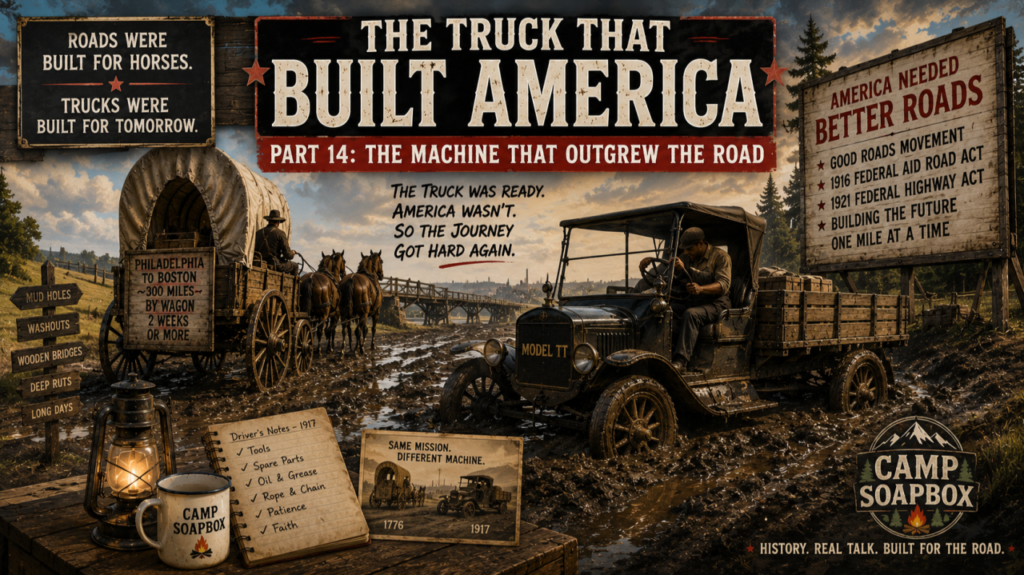
The waggoneer changed seats.
He climbed down from a wooden wagon pulled by horses…
And climbed into a truck powered by an engine.
Same person.
Same mission.
Different machine.
For the first time, freight was no longer limited by how far a horse could walk.
There was only one little problem.
The truck changed.
The road did not.
So let’s adjust the Flux Capacitor.
WOOP… WOOP… WOOP… WOOP…
There.
Early 1900s.
Climb back into that truck with me.
Don’t worry.
We already know what to expect.
No air ride.
No air conditioning.
No sleeper.
No GPS.
No heated seats.
No cup holder for your coffee.
Honestly, that last one might be the worst part.
The engine starts.
The freight is loaded.
The driver pulls onto the road.
And then…
The truck finds the same mud hole his grandfather fought with a wagon.
Because America had a strange problem.
We had invented a machine for the future…
But it was driving on roads from the past.
For generations, roads were built around horses.
Think about that.
A horse could walk around a hole.
A wagon could slowly crawl through rough ground.
If the road got terrible, people expected it.
That was just travel.
But now we had engines.
We had trucks.
We had machines that could move more freight farther than ever before.
Except those machines needed something better underneath them.
A truck stuck in mud was no better than a wagon stuck in mud.
A broken bridge did not care whether you had horsepower or an engine.
America had solved one problem…
And uncovered another.
The country needed roads.
Real roads.
And the push had actually started before trucks became common.
In the late 1800s, a group you might not expect helped start the conversation.
Bicycle riders.
Yep.
Bicycles.
The League of American Wheelmen pushed for better roads because riders were tired of fighting
mud, rocks, and terrible conditions.
The movement became known as the Good Roads Movement.
At first, it was not about trucks.
It was not even about cars.
It was about people wanting a better way to travel.
But then automobiles arrived.
Then trucks arrived.
And a good road stopped being a nice thing to have.
It turned into something the country could not do without.
In 1893, the federal government created the Office of Road Inquiry to study America’s road
problems.
Because people were starting to realize something.
A growing country could not run forever on broken roads.
Then came 1916.
The Federal Aid Road Act.
For the first time, the federal government began putting serious money toward helping states build
better roads.
And the timing could not have been better.
Because one year later…
The Ford Model TT arrived.
The working man’s truck.
The machine that allowed farmers, businesses, and regular Americans to move their own freight.
But those trucks needed somewhere to go.
So America started building.
Slowly.
One mile at a time.
The roads improved.
The trucks improved.
The country changed.
Then in 1921, the Federal Highway Act helped create a more connected highway system.
America was finally beginning to understand something.
A truck was more than a machine.
A truck was a promise.
A promise that something made here…
Could get there.
A promise that farms could reach cities.
Factories could reach customers.
Small towns could connect to the rest of the country.
The waggoneer already knew this.
He had known it since 1776.
The last mile mattered.
Only now…
The last mile was getting longer.
The loads were getting heavier.
The country was getting bigger.
And the little gasoline engines working hard under those trucks were about to face their own limits.
Because while America was busy building roads…
A man in Europe had already invented something that would eventually change trucking forever.
His name was Rudolf Diesel.
But that is our next stop.
So tomorrow morning, we adjust the Flux Capacitor again.
Because the engine that would one day pull America forward…
Was not born inside a truck.
Until then…
Keep the coffee hot.