
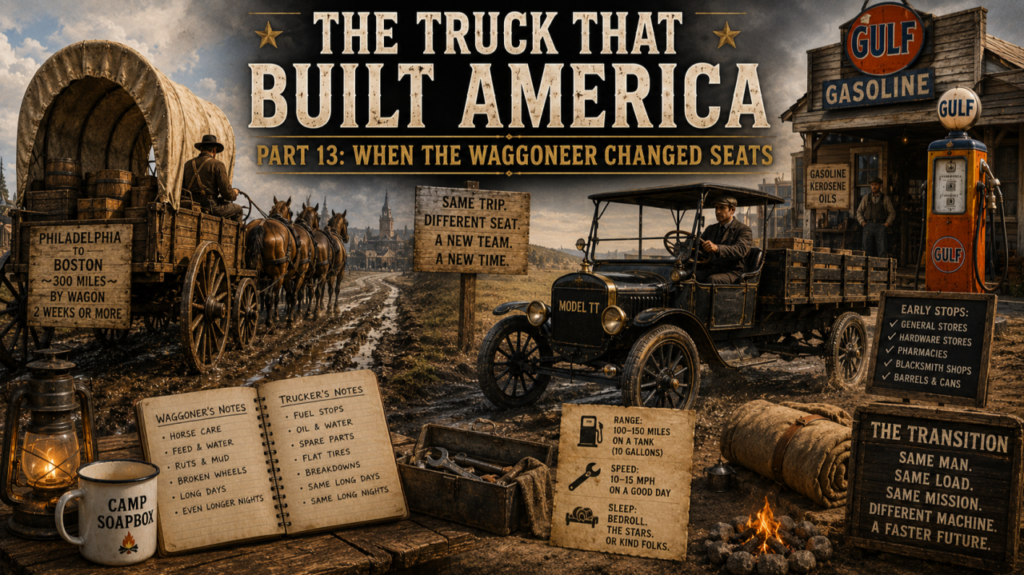
Camp Soapbox | JR Elrod
The truck did not replace the waggoneer. It gave him a new team.
Because that is really what happened.
The old freight men did not just disappear. A lot of the early truck operators came from people
already moving things: teamsters, delivery wagon operators, farmers, merchants. They understood
loads, routes, weather, customers, and responsibility. They just had to learn the machine.
Here is the trip:
We go back to our 1776 trip.
Philadelphia to Boston.
Roughly 300 miles.
With a wagon:
A good freight wagon might average 10-20 miles a day depending on roads, load, weather, and
horses.
That trip could easily be a couple weeks.
Now jump forward.
WOOP… WOOP… WOOP… WOOP…
Early 1900s.
Same trip.
Same freight.
Same driver.
Different seat.
Instead of holding leather reins…
He is holding a steering wheel.
But don’t get too comfortable.
Because this is not your pickup.
No heater.
No air conditioning.
No GPS.
No radio.
No air seat.
No sleeper.
No truck stop waiting with coffee.
The roads?
Many were still terrible.
A lot of roads were built for horses, not trucks.
Mud was still mud.
A rut was still a rut.
A wooden bridge was still a question mark.
Only now, instead of breaking a wagon wheel…
You might break an axle.
Lose a chain.
Ruin a tire.
Have engine trouble.
And there was no roadside service.
The driver WAS roadside service.
He carried:
tools.
parts.
patches.
oil.
water.
rope.
whatever he thought he might need.
Sound familiar?
Because that old waggoneer carried the same things.
The toolbox changed.
The job didn’t.
Then hit fuel.
Because this is fascinating.
At first, there were not gas stations everywhere.
Early motorists bought gasoline from:
general stores
hardware stores
pharmacies
blacksmith shops
barrels and cans
Gasoline was originally a byproduct of kerosene refining. In the early oil days, kerosene for lamps
was the valuable product. Gasoline was not the hero yet.
Then automobiles changed everything.
The first purpose-built drive-in gasoline station is usually credited to 1913 in Pittsburgh,
Pennsylvania, opened by Gulf Refining Company.
Before that?
You planned ahead.
Just like a waggoneer planned water and feed stops.
The horse needed hay.
The truck needed gasoline.
Different fuel.
Same problem.
Range:
A Model TT held around 10 gallons of gasoline.
Fuel mileage depended heavily on load and conditions, but early trucks might get roughly 10-15
miles per gallon.
So maybe around 100-150 miles if things went well.
But remember…
Roads could destroy that.
Mud.
Hills.
Load weight.
Mechanical issues.
Then Midwest and West.
This is important.
People think:
“Truck invented. Everyone switched.”
Nope.
Not even close.
Out West and in rural America, horses stayed around for years.
Why?
Because horses already existed.
Farmers owned them.
They knew how to fix a wagon.
They had feed.
They had barns.
A truck was expensive.
Parts were not everywhere.
Mechanics were not everywhere.
Fuel was not everywhere.
The infrastructure had to catch up.
The truck had to prove itself.
Then the sleeping part.
Early drivers were basically still waggoneers.
No sleeper.
No motel chains.
No truck stops.
If they traveled far enough:
they slept outside.
used bedrolls.
slept near the truck.
found boarding houses.
stayed at farms.
The cabover sleeper and modern sleeper era is decades away.
The ending:
And after the first long trip, our waggoneer climbs down.
His clothes are dirty.
His hands hurt.
His back hurts.
The truck broke.
The road fought him.
The weather fought him.
Just like always.
But then he notices something.
The trip that used to take weeks…
Didn’t.
The horses that needed rest…
Were gone.
The load moved farther.
Faster.
And for the first time in history…
The driver was no longer limited by how far an animal could walk.
America had changed.