
Camp Soapbox | JR Elrod
Your Camp Counselor here.
Grab your coffee and pull up the nearest stump.
All right, campers…
This morning we finally watched it happen.
After all those miles.
After all those years.
After following the waggoneer from muddy trails to turnpikes, canals, railroads, steam, oil,
gasoline, and engines…
The truck finally arrived.
In 1899, Autocar answered a question America had been working toward for over 100 years.
Could we build a machine that could replace the horse?
The answer was yes.
But there was still a problem.
A pretty big one.
Just because something exists does not mean ordinary people can use it.
Those first trucks were expensive.
They were rare.
They were mostly owned by companies with enough money to take a chance on a new machine.
Big businesses.
Large delivery operations.
Companies that could afford the experiment.
But the farmer?
The small business owner?
The same waggoneer we met back in 1776?
He was still standing beside his horses.
The truck existed.
But it wasn’t his yet.
America did not just need someone to invent the truck.
America needed someone to make the truck available.
So let’s adjust the Flux Capacitor again.
WOOP… WOOP… WOOP… WOOP…
There.
Welcome to the early 1900s.
And now we meet a man named Henry Ford.
Now before anyone gets excited…
Henry Ford did not invent the automobile.
He did not invent the truck.
Those wheels were already turning.
What Henry Ford figured out was something completely different.
How do you build one fast enough…
And cheap enough…
That regular people can actually buy it?
That question changed everything.
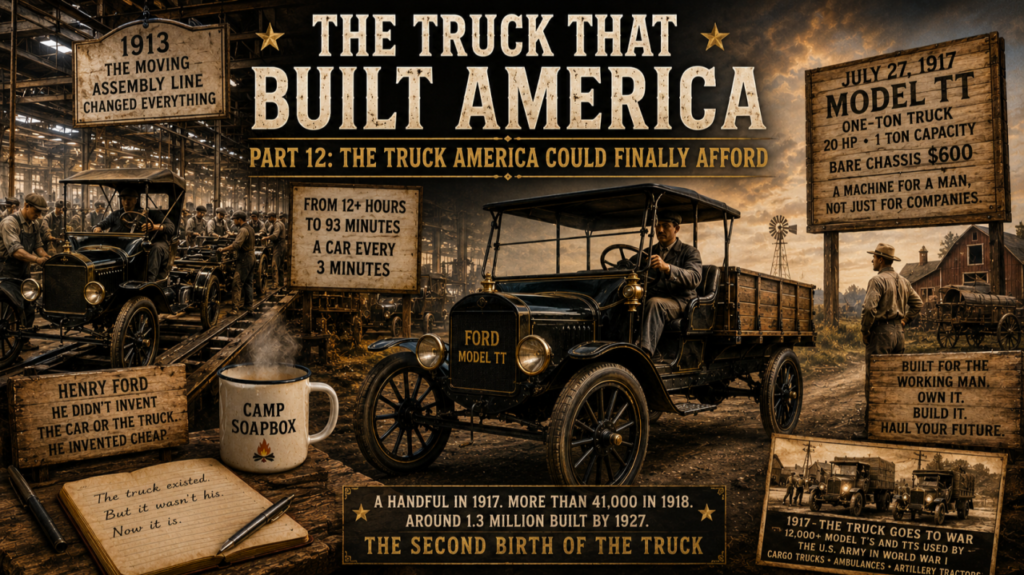
In 1913, Ford introduced the moving assembly line.
Instead of workers moving around the vehicle…
The vehicle moved past the workers.
Each person had a job.
Each person did their part.
And little by little, the impossible started happening.
The time it took to build a vehicle dropped dramatically.
Production increased.
Prices dropped.
Machines that once belonged only to the wealthy started showing up in ordinary driveways.
And then Ford turned his attention to something else.
The truck.
On July 27, 1917, Ford introduced the Model TT.
Now don’t picture a modern pickup.
Don’t picture a semi.
This was simple.
A stronger version of the Model T.
A tougher frame.
A longer wheelbase.
A heavier rear axle.
A machine built to work.
It had around 20 horsepower.
It was not fast.
In fact, compared to what we drive today…
It was painfully slow.
But speed was not the point.
The point was freedom.
A farmer could buy one.
A shop owner could buy one.
A working man could buy one.
Ford sold the chassis, and people built what they needed.
Need a flatbed?
Build one.
Need a delivery truck?
Build one.
Need something to haul crops?
Build one.
For the first time, the truck belonged to the people who actually needed it.
And think about our old friend the waggoneer.
For generations he fought mud.
Broken wheels.
Tired horses.
Bad weather.
Bad roads.
He was the final mile.
Now he climbed down from that wooden wagon seat…
And climbed into something new.
Same person.
Same mission.
Different machine.
The horse did not fail America.
The horse carried America as far as it could.
But now America was moving faster.
Growing bigger.
Reaching farther.
And it needed something that could keep up.
The Model TT exploded.
A handful were built in 1917.
Over 40,000 followed in 1918.
And before it was replaced in 1927, Ford had built over a million of them.
The truck was no longer a curiosity.
The truck was everywhere.
And there is something else about that year.
The same year the Model TT arrived…
America entered World War I.
And the truck went with her.
Cargo.
Supplies.
Ambulances.
Equipment.
The machine built for the working man was suddenly working for an entire country.
So now we finally have it.
The truck exists.
The working man can afford it.
America has the machine.
But there is still one problem.
Because a truck can only go where the road lets it.
And America was about to discover that building millions of vehicles was the easy part.
Connecting an entire country?
That was going to take something much bigger.
So next time, we adjust the Flux Capacitor again.
Because America is about to build the roads that let the truck truly change everything.
Until then…
Keep the coffee hot.