
Camp Soapbox | JR Elrod
Your Camp Counselor here.
Grab your coffee and pull up the nearest stump.
All right, campers…
Before we adjust the Flux Capacitor again, I think we need to stop for just a minute and look
behind us.
Because sometimes when you are traveling through history, you need to see just how far you have
already gone.
When this journey started, we were standing at the beginning of a new nation.
America had declared independence.
A new country was born.
But that new country had a problem.
Moving things was hard.
Really hard.
If you needed to move freight inland, you needed a waggoneer.
A team of horses.
A wooden wagon.
And roads that sometimes barely deserved to be called roads.
Those early waggoneers connected towns, farms, ports, and people.
It worked.
But it had limits.
America needed better roads.
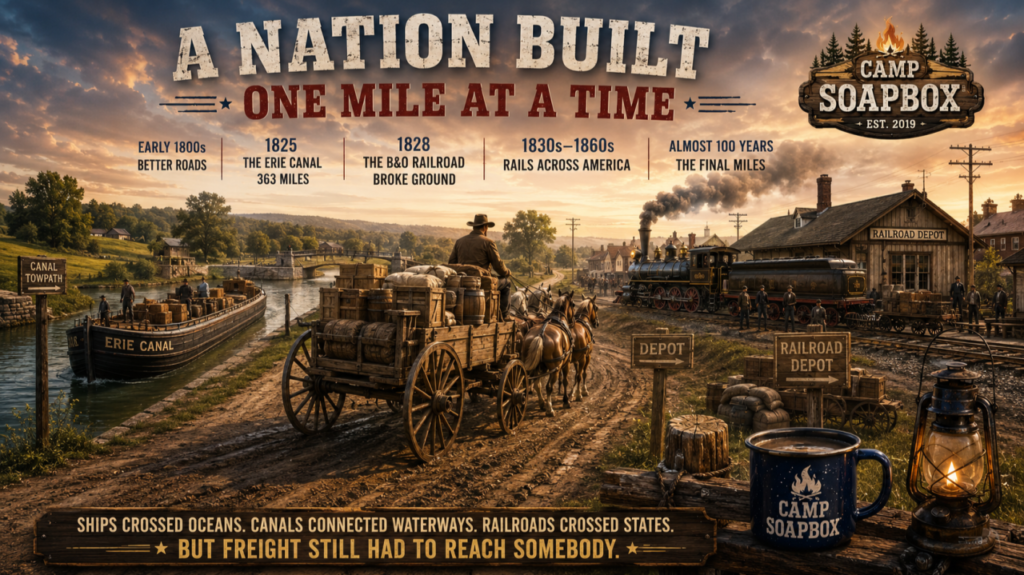
By the early 1800s, roads like the Lancaster Turnpike showed what was possible.
Better roads meant heavier loads, faster trips, and more reliable transportation.
The country was learning.
Then came another jump forward.
In 1825, the Erie Canal opened.
363 miles of water connecting the Hudson River to Lake Erie.
Suddenly freight that once took weeks to move could travel faster and cheaper than anyone thought
possible.
America got a little smaller.
But there was still a problem.
The canal only went where the water went.
So America kept building.
In 1828, the Baltimore and Ohio Railroad broke ground.
At first, those rails were not even about replacing the horse.
They were about helping it.
Then steam entered the picture.
The railroad began changing everything.
Iron rails stretched across the country. Towns grew beside them. Businesses followed them.
Families used them to move west and start new lives.
The railroad became one of the most important inventions in American history.
But even the railroad had limits.
Because the railroad stopped at the depot.
The canal stopped at the dock.
And somebody still had to finish the trip.
Standing there waiting was the same person who had been there from the beginning.
The waggoneer.
Think about that for a second.
After almost 100 years of progress…
After better roads.
After canals.
After steam engines.
After railroads.
America still depended on a person, a wagon, and a team of horses to finish the job.
Because America was not replacing transportation.
America was building a system.
Each invention solved a problem.
Each invention opened the door for the next one.
And that brings us back to the question that started this whole journey.
What would America look like if trucks had never been invented?
Well folks…
Now we are starting to see the answer.
Ships could cross oceans.
Canals could connect waterways.
Railroads could cross states.
But freight sitting at a dock was not delivered.
Freight sitting at a depot was not delivered.
Freight sitting in a rail yard was not delivered.
Somebody still had to carry it the rest of the way.
The final miles still mattered.
This afternoon, we make another adjustment to the Flux Capacitor.
America is growing.
The freight is growing.
The demand is growing.
And that old system is about to get pushed harder than ever before.
Until then…
Keep the coffee hot.