
Camp Soapbox | JR Elrod
Your Camp Counselor here.
Grab your coffee and pull up the nearest stump.
All right, campers…
Let’s move ahead just a couple of years.
Hang on…
I need to adjust the Flux Capacitor.
WOOP… WOOP… WOOP… WOOP…
There.
1827
Now this is interesting.
Yesterday we watched DeWitt Clinton change America by digging a canal where there wasn’t one.
The Erie Canal was a tremendous success.
Freight moved farther.
Freight moved faster.
Freight moved cheaper.
But there was still one problem.
If your town wasn’t sitting next to the canal…
You were still waiting on the waggoneer.
America had solved one transportation problem.
Now she had another.
Come here.
I want to introduce you to another group of people.
This time…
Not one man.
An entire company.
The Baltimore & Ohio Railroad.
If you’ve ever played Monopoly, you’ve seen the B&O Railroad.
Most people never stop to think it was a real company.
It was.
And in 1827, the people behind that company were worried.
Very worried.
The Erie Canal had turned New York City into the busiest port in America.
Merchants in Baltimore watched business, freight, and opportunity head north instead of south.
They knew if they didn’t do something…
Their city would be left behind.
So they asked a simple question.
“What if we built a road out of iron?”
Now here’s the part that surprised me while I was researching this.
The B&O wasn’t built for steam locomotives.
Not at first.
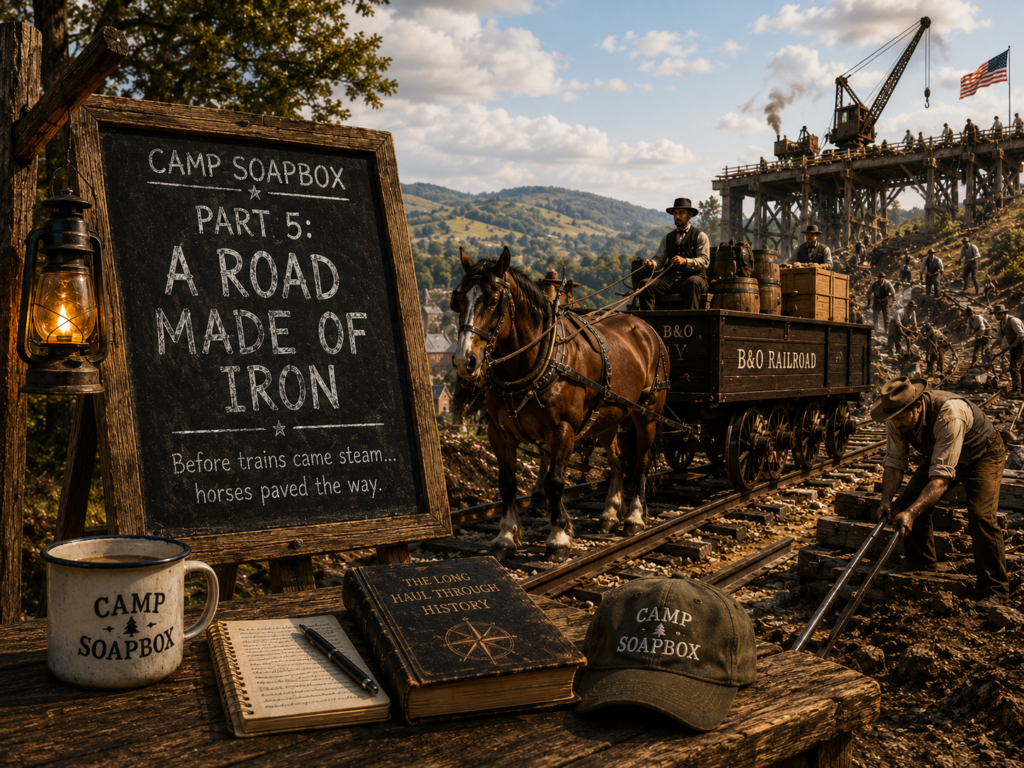
The original plan was to use horses.
The same horses.
The same freight.
The same drivers.
The only difference…
Instead of dragging a wagon through mud…
The horse would pull a railcar across smooth iron rails.
Think about that for a minute.
It wasn’t replacing the horse.
It was helping the horse.
A single horse could pull far more weight on iron rails than it ever could on a dirt road.
Less effort.
More freight.
Longer distances.
Sometimes the biggest changes don’t come from replacing something.
They come from making it better.
Construction began almost immediately.
Thousands of laborers cleared forests.
Blasted rock.
Filled ravines.
Built bridges.
And laid iron rail one section at a time.
Imagine standing beside them.
You hear the steady ring of hammers.
The crack of black powder echoing through the hills.
Men shouting measurements back and forth.
Sweat running down their faces as they wrestled heavy iron into place.
None of them knew exactly what the future looked like.
But every one of them knew they were building something America had never seen before.
One year later…
On July 4, 1828…
The cornerstone of the Baltimore & Ohio Railroad was laid.
And the man who placed it wasn’t just anyone.
It was Charles Carroll.
The last surviving signer of the Declaration of Independence.
Think about that for a moment.
One of the men who helped give birth to our nation…
Was helping dedicate the first great railroad that would help build it.
History has a funny way of connecting the dots.
Now…
Here’s something else I stumbled across that made me smile.
The railroad builders hadn’t settled on steam yet.
In fact…
They tried some ideas that sound downright crazy today.
One experiment used sails.
Yes…
A sail.
On a railcar.
Another put the horse inside the railcar on a giant treadmill to turn the wheels.
I’m not making that up.
Sometimes progress looks a little ridiculous before it looks brilliant.
Problem solved.
Right?
Not quite.
Because while the Baltimore & Ohio was experimenting…
One man believed there was a better answer.
His name was Peter Cooper.
Most people thought he was dreaming.
Tomorrow…
We’re going to meet Peter Cooper.
We’re going to watch his little steam locomotive race a horse.
And believe it or not…
That race helped convince America that the future wasn’t standing in a stable.
It was building steam.
Before we head back to the present, I want you to remember one thing.
History doesn’t usually leap forward.
It inches forward.
One good idea at a time.
Until then…
I need to make one more adjustment to the Flux Capacitor.
Keep the coffee hot.