
HIGHWAY FEVER
COMMENTARY & EDITORIAL
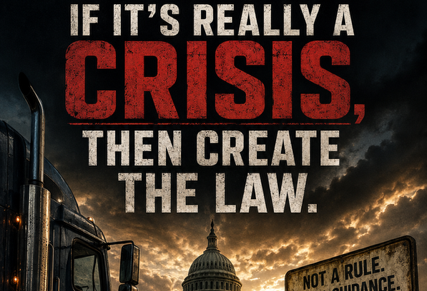
IF IT’S REALLY A CRISIS, MAKE IT LAW
For months, the American trucking industry has been told there is a crisis.
We have been told the commercial driver’s license system has been compromised. We have heard repeated concerns about improperly issued CDLs, non-domiciled licenses, English-language proficiency, driver qualification standards and the quality of entry-level driver training.
Washington has responded.
There have been enforcement initiatives, investigations, license reviews, regulatory changes and threats of consequences for states that fail to comply with federal requirements.
With nearly every announcement comes another declaration that the problem is finally being addressed.
Perhaps it is time to ask a more important question.
If this is truly a national highway-safety crisis, why hasn’t Congress made the solution law?
There is an important distinction between an administrative rule and a law enacted by Congress.
Federal agencies have substantial regulatory authority, and regulations can carry significant legal consequences. But regulations are created and administered within the executive branch. They can be challenged in court, reconsidered, amended or replaced through subsequent administrative action.
An Act of Congress is something altogether different.
That distinction matters, particularly now.
The United States is approaching the 2026 midterm elections amid considerable political division. Control of Congress could change. Committee leadership could change. Legislative priorities could change.
Regardless of what happens in November, another reality is unavoidable: eventually, there will be another presidential administration.
There will be another secretary of transportation.
There will be another FMCSA administrator.
And there will inevitably be different political priorities.
The trucking industry should therefore be asking not simply what Washington is doing today, but what remains when the people making today’s decisions are no longer there.
What happens if a future administration takes a different approach to English-language enforcement?
What happens if another administration decides the current restrictions surrounding non-domiciled CDLs should be reconsidered?
What happens if enforcement priorities change?
What happens when regulations are challenged, rewritten or replaced?
Those are not partisan questions. They are questions about the durability of public policy.
If the federal government genuinely believes that improperly issued commercial driver’s licenses threaten highway safety, Congress should establish clear statutory safeguards.
If the ability to understand highway signs, communicate with law enforcement and respond to safety instructions in English is considered essential to safely operating a commercial motor vehicle, then Congress should provide that standard with the strongest and clearest legislative foundation possible.
If weaknesses in entry-level driver training have allowed inadequately prepared drivers onto America’s highways, then Congress should determine what minimum national standards are necessary and establish meaningful accountability for the institutions responsible for providing that training.
These questions deserve more than temporary political attention.
They deserve legislation.
Write the bill.
Hold the hearings.
Allow both parties to debate it.
Amend it where necessary.
Bring it to the floor.
And require every member of Congress to put his or her name beside a vote.
Then the American trucking industry will know exactly where its elected representatives stand.
Because regulations alone do not resolve the larger problem.
If national commercial-driver standards change substantially depending upon which political party controls the executive branch, America has not established a lasting national policy. It has established a regulatory pendulum.
Trucking has lived with that pendulum for decades.
One administration emphasizes enforcement. Another changes direction. New officials arrive with new priorities, and the industry finds itself debating many of the same issues it was supposedly fixing years earlier.
Highway safety should not operate that way.
There should not be Republican standards for operating an 80,000-pound commercial vehicle and Democratic standards four years later.
There should be American standards.
Standards that apply regardless of where a driver was born.
Standards that apply regardless of which company employs that driver.
Standards that apply regardless of which state issued the license.
And standards that remain in place regardless of who occupies the White House.
The midterm elections are approaching quickly. The political composition of Congress may look considerably different after November, and the opportunity to enact broader legislation could become more difficult.
That makes the question increasingly urgent.
If the CDL, non-domiciled licensing, English-proficiency and driver-training issues confronting trucking are genuinely as serious as Washington has repeatedly told the American public they are, then temporary administrative action should never have been the final destination.
It should have been the beginning.
Congress has the authority to debate these issues and establish durable federal law.
The trucking industry should demand that it do so.
Because administrations change.
Agency officials change.
Political majorities change.
Highway safety should not.
If this is truly a crisis, make the solution bigger than politics.
Make it law.
Charles Claburn
Highway Fever