
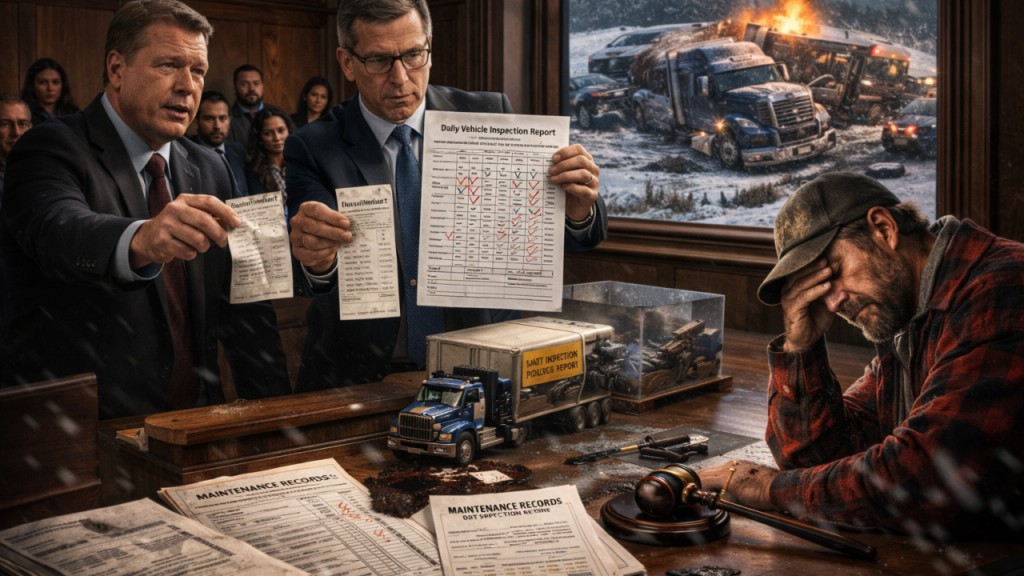
Pre-trip inspection report held up as courtroom evidence while a truck driver sits with his head in his hands
Why armchair inspections will cost you everything, and how to know if your drivers are actually looking
Ok folks, your Camp Soapbox counselor here.
Grab your coffee and pull up the nearest stump.
All right, campers.
Let me tell you how most trucking companies find out their drivers aren’t doing proper pre-trip inspections.
Option 1: The driver calls and says, “Hey, I need brakes on the truck NOW!”
Option 2: The driver calls from the side of the road with a burned-up axle because he let his hub oil run dry from a leaking wheel seal.
Option 3: The truck shuts down on the side of a mountain because nobody noticed the leaking water pump or heater hose until the engine overheated from low antifreeze.
Option 4: You get a call from a lawyer because a set of duals came off and went into oncoming traffic, killing someone.
Option 5: Your driver gets caught in a 30-vehicle winter pileup that wasn’t his fault. Until the cops find the brake light that hasn’t worked in weeks.
If you’re waiting for options 1 through 3 to tell you there’s a problem with your maintenance program, you’re lucky.
If you get option 4 or 5, you’re done.
The Accident That Wasn’t Your Fault (Until It Was)
Let me paint you a scenario that happens every winter.
Your driver is trucking along in winter conditions. Roads are crap. Suddenly the car ahead of him spins out. Your driver does everything right. He gets it shut down, maintains control, maybe just taps the car in front of him. No damage. Everyone’s okay.
Now he’s sitting on the road. Winter conditions. Low visibility. Heavy traffic.
Another car barrels into the rear of his truck. Then another. Then another. What follows is a 30-vehicle pileup with injuries, maybe fatalities.
Your driver didn’t cause this. The dashcam will verify it. The car spun out in front of him. He reacted properly. He did his job.
But here’s what happens next.
The cops come out. DOT comes out. They’re there to help extract people from this horrible accident. But they’re also there to determine the cause.
And they start looking at your truck.
They find a tail light that’s not working.
Now here’s where it gets interesting. Let’s say the car that hit the rear of your trailer hit the right side. The tail light that’s out is on the left side. It didn’t even matter in this accident.
Or maybe the tail lights on the trailer work fine, but the brake lights on the truck itself, the ones underneath the trailer that you can’t even see from the rear, those don’t work.
Why does this matter?
Because someone in one of those cars got injured. Not from anything your driver did. But they’re injured. And now the lawyers are involved.
What Happens When the Lawyers Show Up
Here’s what plaintiff attorneys do when they’re building a case.
They will pick apart your driver’s life, personal and professional.
They’ll examine his driving logs. His pre-trip inspections for the last year. His personal driving record. His training records. His employment history. His social media posts.
They will pick apart your truck.
Believe me when I tell you, they will insist on doing a full DOT inspection on that truck and trailer. And guess what?
Those tail lights that don’t work? That’s going to cost you a massive amount of money in court.
That brake that’s slightly out of adjustment? That’s evidence of negligence.
That tire with tread at 3/32 when the legal minimum is 2/32? That’s going in front of the jury.
They will pick apart your company.
Then they’ll come into your office and look at every piece of paper that has anything to do with your trucks. Not just the one involved in the accident. All of them.
What are they looking for? A pattern of neglect.
Let’s say you have 10 trucks and all of them have drivers doing armchair inspections. The attorney will pull records and show the jury an out-of-service violation on truck 1 for brakes eight months ago. A scale inspection on truck 2 that found defective lights six months ago. A roadside inspection on truck 3 that found loose lug nuts four months ago. And so on down the line.
They will determine you neglected your duty. That safety is not your priority. Making money is.
Even though maybe you do care about safety. Even though maybe you do get stuff fixed as soon as you know about it.
Your defense cannot be, “Well, I don’t know what’s wrong with the equipment unless my drivers tell me.”
Here’s What the Attorney Will Say in Court
“Your honor, let me show you exhibit A. Fuel receipts from truck 7 over the last 90 days.”
“Notice the driver purchased oil at every single fuel stop. Sometimes a gallon. Sometimes two gallons. That’s 6 gallons of oil in 90 days on a truck that should use maybe 1 gallon between oil changes.”
“Now look at exhibit B. The maintenance records for truck 7. Zero work orders for oil leaks during this period.”
“Either the defendant didn’t know about this leak, which means their inspection program is a fraud, or they did know and chose to have the driver keep topping it off instead of fixing it, which is willful negligence.”
“Let’s look at exhibit C. Walmart receipts from the same truck. Antifreeze. Three times in one month.”
“Notice there’s no maintenance record addressing a coolant leak. That should have been an indicator to the defendant that something was wrong. But they ignored it.”
“Now look at exhibit D. The maintenance history for truck 4, the truck involved in this accident. The last brake job was done three years ago. Three years and 300,000 miles.”
“Ladies and gentlemen of the jury, there is no way that truck didn’t need brakes before this accident. But the defendant’s records show no brake work. Either the driver wasn’t inspecting the brakes, or the company was ignoring his reports. Either way, that’s negligence.”
“And finally, let me show you exhibit E. The DVIR logs for all 10 trucks in the defendant’s fleet over the last year. Notice something? In 365 days, across 10 trucks, there are exactly 14 defects reported. That’s 1.4 defects per truck per year.”
“Your honor, I’ve been practicing transportation law for 20 years. The industry average is 8 to 12 defects per truck per year. The defendant’s fleet somehow operates at one-tenth the defect rate of properly maintained fleets.”
“That’s not because their equipment is better. It’s because their drivers aren’t looking.”
The Jury Already Hates You
Let’s talk about that jury for a minute. You’re starting from behind before the trial even begins.
Maybe someone on that jury got cut off by a truck on their way to court that morning. Maybe someone on that jury was hit by a truck years ago and still has lingering injuries. Maybe someone saw a news special about how trucking companies prioritize profits over safety. Maybe someone just doesn’t like big trucks on the road and thinks they’re all dangerous.
The plaintiff’s attorney knows this. They’re counting on it.
They will paint a picture of you as a greedy carrier who cuts corners, ignores safety, and cares more about money than lives.
And if your maintenance records support that narrative, even a little bit, you’re done.
The Defense You Can’t Make
Here’s what won’t work in court.
“My driver signed the pre-trip inspection every day.” Then why didn’t he report the defects we found?
“We fix things as soon as drivers report them.” Then why are there oil purchases every fuel stop with no repair orders?
“We didn’t know about these issues.” Fuel receipts, Walmart purchases, and inspection patterns say otherwise.
“The defect didn’t cause the accident.” But it shows a pattern of negligence that proves you prioritize schedule over safety. And now my client is injured because your driver was operating an uninspected truck.
“The dashcam shows it wasn’t our driver’s fault.” The dashcam shows the initial spin-out wasn’t his fault. But those brake lights that didn’t work? That might have prevented the car from hitting him. We’ll never know, because your company failed to maintain basic safety equipment.
Just Ask Any Transportation Lawyer
I’m not making this up. Talk to any attorney who practices transportation law. They will tell you that they look for everything.
They will tear apart your maintenance records. Your fuel purchase history. Your training documentation. Your hiring practices. Your safety culture. Your financial records, to prove you’re profitable enough to have maintained the equipment. Your CSA scores and inspection history.
They will tell the jury all about you.
And with the reputation our industry has, thanks to bad actors, headlines about crashes, and the general public’s negative view of truck drivers, you’re already fighting uphill.
The jury wants to believe you’re negligent. The attorney just has to give them the evidence to confirm it.
The Call You Should Be Getting (But Probably Aren’t)
Now let’s go back to prevention. Here’s what a proper pre-trip inspection sounds like.
“Hey, I noticed this morning during my PTI that my brakes are getting low. They’re still legal for now, but I’m going to need them done in approximately 500 miles. Can we schedule that?”
If your driver just called you with that message, congratulations. You have a professional who’s actually doing their job.
If the last time you heard about brake issues was when the driver said he needed them now, you have a problem.
And that problem is this. Your driver isn’t inspecting the truck. He’s guessing.
Armchair Inspections Are Industry Standard (And That’s Terrifying)
Let’s be honest about what happens at most carriers.
The driver walks around the truck with a clipboard or tablet. He marks everything OK. He starts the engine and rolls out.
He never checked brake lining thickness. Never looked under the truck for leaking fluids. Never inspected wheel seals for oil residue. Never verified tire pressures. Never checked coolant levels. Never examined airlines and glad hands. Never tested all the lights. Never actually crawled under to see what’s going on.
He did an armchair inspection. Looking at the truck from a comfortable distance and assuming everything’s fine because it was fine yesterday.
Then he’s 300 miles down the road when the wheel bearing seizes, because that seal’s been leaking for a week and nobody noticed.
Or he’s sitting in court explaining to a jury why he signed off on a pre-trip inspection that somehow missed three non-functioning brake lights.
How Do You Know If Your Drivers Are Actually Inspecting?
Here’s the truth. You know by what they’re not catching.
We catch our drivers skipping inspections all the time. Here’s how.
Red Flag 1: Emergency repair calls
If your driver calls and says he just burned up an axle, that wheel seal didn’t start leaking five minutes ago. It’s been leaking for days, maybe weeks.
A driver doing proper daily inspections would have called and said, “I’ve got oil on the outside of my tire and wheel. Looks like a leaking seal. We should get this looked at.”
That’s a $200 to $500 seal replacement at a shop.
Instead, you get a $3,000 to $5,000 axle rebuild on the side of the road, plus downtime, plus towing, plus a customer wondering where their freight is.
Red Flag 2: “I need it now” maintenance requests
Brakes don’t go from perfect to illegal overnight. They wear gradually. A driver doing daily inspections can see the progression. Plenty of lining left. Then getting thinner. Then close to minimum. Then done.
If your driver waits until he’s at the scale getting written up before mentioning brake issues, he hasn’t been looking at those brakes for weeks.
Red Flag 3: Scale violations
Here’s a fact that should scare every carrier. When your driver gets a fix-it ticket at the scale, the company gets the violation, not just the driver.
Most states won’t let the driver off completely free if he should have reported it. He can get a ticket too if it’s serious enough.
But at the end of the day, that’s your CSA score taking the hit. That’s your safety rating. That’s your insurance premium going up.
And if the violation is bad enough, out-of-adjustment brakes, cracked frame rails, bald tires, that’s your truck sitting in the parking lot while you scramble to get it fixed and explain to your customer why their load is late.
Red Flag 4: Your fuel purchase reports
Want to know if your drivers are skipping inspections? Look at what they’re buying at the fuel stop.
Buying a lot of antifreeze? Something’s leaking, and it has been for a while. Buying a lot of oil? You’ve got an oil leak or you’re burning oil, and it should have been reported. Buying tire sealant or Fix-a-Flat? They have a slow leak they’re trying to patch instead of replacing the tire.
We check fuel purchase reports specifically for this. If we see a pattern of the same truck buying coolant or oil every fuel stop, we call that driver and ask what’s going on.
Nine times out of ten, the answer is, “Oh, it’s just a small leak. I’ve been topping it off.”
No. Stop the truck. Get it fixed. Now.
Because when you’re sitting in court, that fuel receipt history becomes exhibit A in the plaintiff’s case that you knew about defects and ignored them.
Red Flag 5: Tire failures
Here’s one we see constantly. The driver doesn’t want to stop for a tire replacement because it takes too long at a truck stop.
So he runs on a tire he knows is bad, low tread, visible damage, whatever, hoping it’ll make it to the delivery.
Then it blows. Or worse, it delaminates at highway speed and takes out the fender, airlines, and ABS wiring.
Now instead of a planned 2-hour tire replacement at a truck stop, you’re looking at a 6-hour roadside repair plus several thousand dollars in additional damage.
We’ve learned this lesson. If it’s late and the tire shops are closed, we still have the driver stop at a truck stop if it’s an emergency. If the wait is going to be hours, we call out a mobile service truck to swap the tire.
Yes, it costs more. A mobile service call might be $300 to $500 versus $150 to $250 at a shop.
But we get our truck rolling hours quicker, and more importantly, we prevent the catastrophic failure that would cost ten times more. And we have documentation that we prioritized safety over schedule.
It’s Not Just About Money. It’s About Staying Out of Court.
Let me be blunt about what we’re really talking about here.
Scenario 1: The winter pileup
Your driver does everything right. Car spins out. He stops safely. Gets rear-ended through no fault of his own. Multiple injuries. Lawyers get involved.
DOT inspects the truck and finds two brake lights not working, one brake slightly out of adjustment, and tire tread at 3/32, barely legal.
Your driver’s dashcam proves he wasn’t at fault for the initial incident.
But now the plaintiff’s attorney argues that the non-functioning brake lights may have contributed to the subsequent collisions. That the out-of-adjustment brake indicates a pattern of poor maintenance. That the marginal tire tread shows you run equipment to the legal minimum instead of the safe maximum.
They pull your fleet records and find similar issues across multiple trucks.
The jury hears this. “This isn’t an isolated incident. This is a company culture that treats safety as optional.”
You lose. Massive settlement. Increased insurance premiums. Possible FMCSA investigation. Maybe you lose your authority.
All because of a brake light that’s been out for two weeks and nobody reported it.
Scenario 2: The brake failure
Your driver has been ignoring worn brakes for weeks. He gets to a scale. Inspector finds the brakes out of adjustment or below minimum thickness.
Best case, out-of-service order. Truck gets towed. Repairs get made. You’re out thousands of dollars and a day of revenue.
Worst case, those brakes fail before the scale. Your driver rear-ends a minivan full of kids at a stoplight because he couldn’t stop in time.
Now you’re not just paying for repairs. You’re paying for funerals. And lawyers. And settlements. And the knowledge that someone died because your driver didn’t do his job and you didn’t make sure he was doing his job.
Scenario 3: The wheel-off
Your driver has been ignoring a leaking wheel seal for days. You can see the oil streaks on the wheel. It’s obvious.
The bearing runs dry. It seizes. The wheel comes off.
If you’re lucky, it goes into the ditch.
If you’re not lucky, it goes into oncoming traffic and kills someone.
At the end of the day, as a driver, it is your responsibility to protect the general public from being killed by your truck.
Not because you hit something. Because you refused to report brakes that weren’t working. Because you refused to report a wheel seal that was leaking. Because you did an armchair inspection instead of a real one, and now someone else is dead because of it.
Whose Responsibility Is This?
The driver’s job:
Conduct thorough daily pre-trip and post-trip inspections. Report issues immediately when found. Refuse to operate unsafe equipment. Document everything on the DVIR. And understand that his signature on that inspection is a legal document that will be used in court.
The company’s job:
Make sure drivers are trained on what to look for during inspections. Provide the time and resources for proper inspections, not “you have 10 minutes, hurry up.” Get repairs done quickly when issues are reported. Create a culture where reporting problems is rewarded, not punished. Monitor fuel purchases, repair patterns, and violation history for red flags. Verify through spot audits that drivers are actually doing inspections. Maintain documentation that proves you prioritize safety over schedule.
Where most companies fail:
They assume the driver is doing the inspection because the driver signed the DVIR.
They don’t follow up on patterns like repeated fluid purchases, emergency repair calls, and scale violations.
They penalize drivers for downtime, so drivers hide problems until they become catastrophic.
They don’t train drivers properly on what to look for, so drivers don’t know what a bad wheel seal looks like or how to check brake adjustment.
And they don’t realize that every decision they make is creating evidence for the plaintiff’s attorney who will eventually sue them.
How to Actually Fix This
1. Train your drivers properly.
Don’t just hand them a CDL and assume they know how to inspect equipment. Show them what a leaking wheel seal looks like. How to measure brake lining thickness. What normal fluid levels should be. How to identify tire damage beyond “does it look flat?” What noises, smells, or changes indicate problems. And that their signature on the DVIR is a legal document that will be examined in court.
2. Require photo documentation.
Make drivers send photos of critical components during inspections. Brake linings. Tire tread depth. Any leaks, damage, or unusual wear. Fluid levels. All lights functioning.
You’ll know immediately if they’re actually looking or just checking boxes. And you’ll have documentation that proves your inspection program is legitimate.
3. Monitor the data.
Fuel purchase reports for repeated purchases of fluids. Repair history for patterns of emergency repairs. DVIR history to see whether issues are being caught early or only when critical. Scale violations, which are your report card on whether inspections are happening at all.
Document your monitoring. Show that you’re actively looking for red flags.
4. Make reporting problems easier than hiding them.
If a driver reports an issue and gets yelled at for the downtime, he’ll stop reporting issues.
If a driver reports an issue and hears “thanks for catching that, let’s get it fixed,” he’ll keep reporting.
Create a culture where catching problems early is celebrated, not punished. And document that culture. Driver safety bonuses. Recognition programs. Anything that shows a jury you value safety over schedule.
5. Get repairs done fast.
Nothing discourages reporting like watching an issue sit for weeks while dispatch keeps saying “we’ll get it scheduled.”
If a driver reports a problem, fix it. Quickly. Even if it’s inconvenient. Even if it costs more.
Because the alternative is that driver stops reporting problems, and then you find out about them when the truck breaks down or fails inspection. Or when you’re sitting in court.
6. Spot audits.
Randomly have a mechanic or qualified inspector check trucks that drivers just signed off as OK.
If that truck has obvious issues the driver missed, you know you have a training problem or a compliance problem.
Address it immediately. Document the audit. Document the corrective action. Document the follow-up training.
Because someday, you might need to show a jury that you take inspections seriously.
The Stakes Are Higher Than You Think
Every time a driver skips a proper inspection, you’re gambling with your CSA score. Your insurance rates. Your DOT authority. Your customer relationships. Someone’s life. And you’re creating evidence for the lawsuit you don’t know is coming yet.
When you lose that gamble, the consequences are catastrophic.
Roadside repairs run $2,000 to $10,000 and up. Towing, $500 to $3,000 and up. Downtime costs you lost revenue plus customer penalties. Scale violations bring fines plus CSA points. Insurance premiums climb by thousands per year. Catastrophic failure lawsuits run into the millions. And loss of authority costs you everything.
Then there’s the part you can’t put a number on. Injured drivers. Injured motorists. Fatalities. And the knowledge that every bit of it was preventable.
You cannot afford to assume your drivers are doing proper inspections. You have to verify.
The Bottom Line
The pre-trip inspection your driver isn’t doing is the lawsuit you’re about to defend.
That brake light that’s been out for two weeks? That’s exhibit A in the negligence case.
Those fuel receipts showing repeated oil purchases with no repair orders? That’s exhibit B proving you knew about defects.
That brake that’s slightly out of adjustment on the truck that got rear-ended in the winter pileup? That’s exhibit C showing you run equipment to minimum standards.
Your fleet-wide DVIR history showing impossibly low defect rates? That’s exhibit D proving your inspection program is a fraud.
This is preventable. Completely preventable.
Train your drivers. Give them the time and tools to inspect properly. Create a culture where reporting problems is expected and rewarded. Monitor the data. Fix issues fast. Document everything.
And for the love of everything, stop accepting armchair inspections as good enough.
Because the scale inspector won’t accept it. The lawyer won’t accept it. The jury won’t accept it.
And the family of the person injured in that pileup, the one that wasn’t even your driver’s fault until the cops found those brake lights that didn’t work, they definitely won’t accept “we didn’t know.”
Do the inspection. Report the issues. Fix the problems. Document everything. Protect the public. Protect your company. Protect your livelihood.
It’s not optional. It’s not negotiable. It’s the bare minimum of being a professional carrier.
And if you’re not doing it, you’re one accident away from learning this lesson the way that costs millions of dollars and destroys everything you’ve built.
The lawyer is coming. The only question is whether you’ll have the documentation to defend yourself.
So here’s what I want out of you.
If you’re an owner, go pull 90 days of fuel receipts on your worst truck. Tonight. I’ll bet you a cup of coffee it isn’t nothing.
If you’re a driver, tell me I’m wrong. Tell me your company gives you the time to do it right. Tell me what happens at your outfit when you write something up. Because I’ve heard both answers, and I want to know which one is winning out there.
And if you’ve been on the wrong end of one of these cases, from any seat, say so. That’s the story nobody tells, and it’s the one that would do the most good.
End of transmission.
JR Elrod
Your Camp Soapbox Counselor